Independent Personal Trainer NYC: Rates, Spaces and the Benchmark

More NYC fitness coaches are leaving the gym and going independent than at any point in recent memory. The income upside is real. So are the risks. And almost every trainer leaping is pricing their services without a single data point to tell them if the number they picked reflects the market, or just what they thought they could get away with charging.
The independent personal trainer in NYC is not a new archetype. What is new is how many coaches are making the move and how deliberately the ecosystem around them has organized itself to support it. A growing number of NYC facilities are built specifically for independent trainers — not commercial gyms that tolerate them, not boutique studios with rigid class schedules, but purpose-built spaces where coaches rent by the hour, keep 100% of their session fees, and run their own business on their own terms.[1]
The income case for going independent is straightforward. At a big-box gym, trainers typically take home 30 to 50% of the session fee — the rest goes to the facility. A gym that charges a client $150 per session might pay the trainer $45 to $75 of that. An independent trainer charging that same client $130 keeps $130, minus space rental.[2] If you are paying $150 per session at a chain gym, the trainer might only be earning $40 to $60 of that.[3]
But there is a version of this story that does not get told clearly enough, and Superset is going to tell it. The independent training model has real upside — and real structural risks. The biggest one is pricing. Most coaches who go independent in NYC set their session rates without reliable public data on what comparable coaches in their market are actually charging. They guess. They ask a friend. They Google "how much should a personal trainer charge in NYC" and get an answer that ranges from $50 to $400. None of that is a benchmark. And in a market where the right rate is the difference between a thriving business and a cash-flow crisis, pricing blind is the most expensive mistake an independent coach can make.
This article covers the real economics of going independent in NYC, the spaces, the models, the rates by neighborhood, the cost structure, and the math of building a sustainable practice. And it makes the case for why the data Eightsets is building is not just useful for independent coaches. For the independent trainer specifically, it is the foundation of every smart business decision they will make.
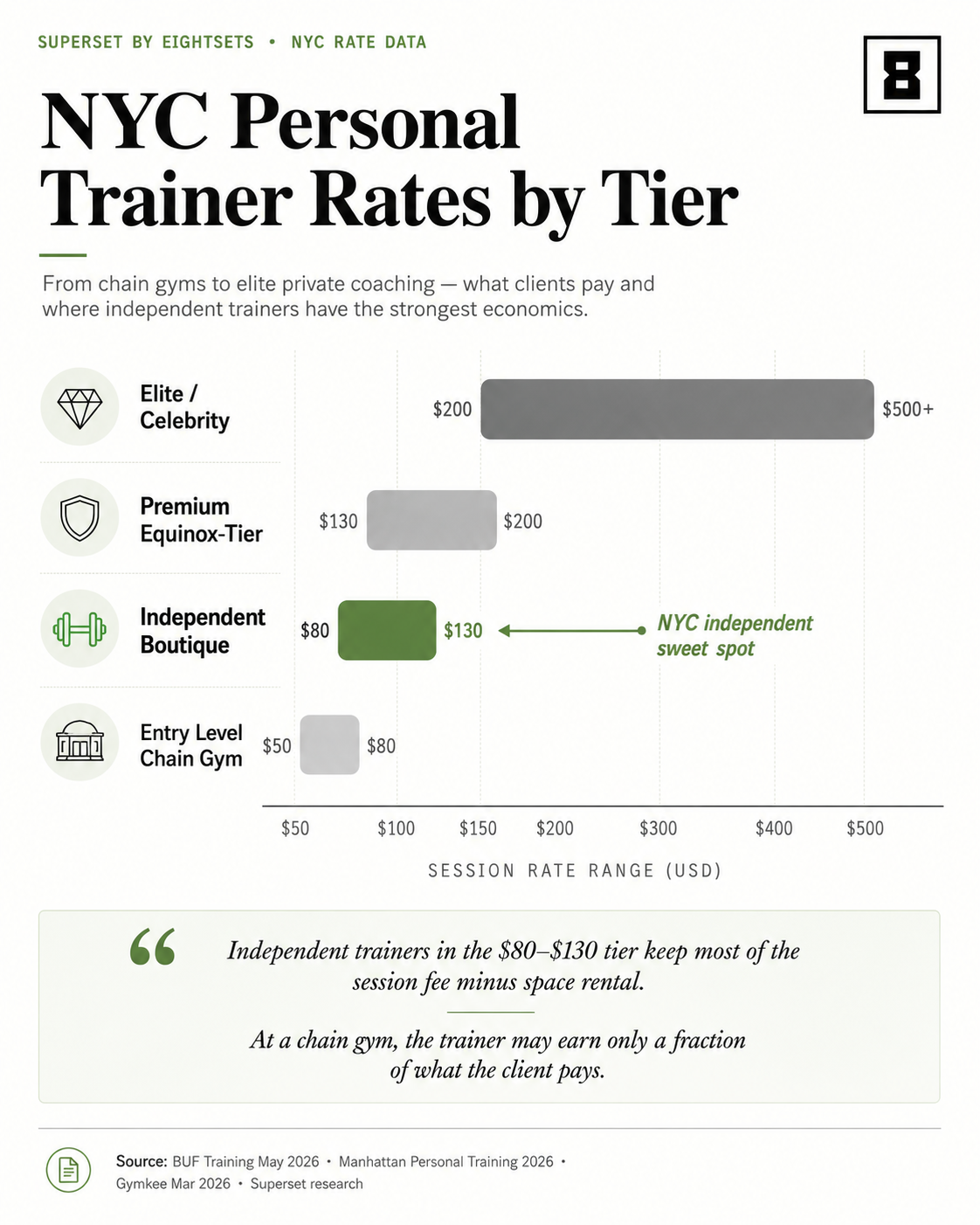
■ The NYC Session Rate Landscape in 2026
Before anything else, coaches need to understand what the NYC market actually looks like in terms of client-facing session rates. The range is wide — $50 to $500 — and almost none of that range is useful without knowing which tier you are in, which neighborhood you work in, and what kind of client you are serving.
The independent and boutique tier is where most coaches transitioning out of gym employment will land — and where the most important pricing decisions happen. Inflation alone has eroded 19% of purchasing power since 2022. A trainer who was charging $90 per session in 2022 and has not raised rates since is functionally earning what $73 per session bought then. The market has moved. Most rate cards have not.[4]
■ What It Costs to Train by NYC Neighborhood
Location is one of the most significant rate drivers in the NYC market — and one of the least discussed. Trainers in the West Village or Upper East Side might ask $140 to $200 per session, while Lower Manhattan or the outer boroughs run more like $100 to $150. These are not just differences in what clients will pay — they reflect real differences in overhead, transit time, and clientele expectations.[5]
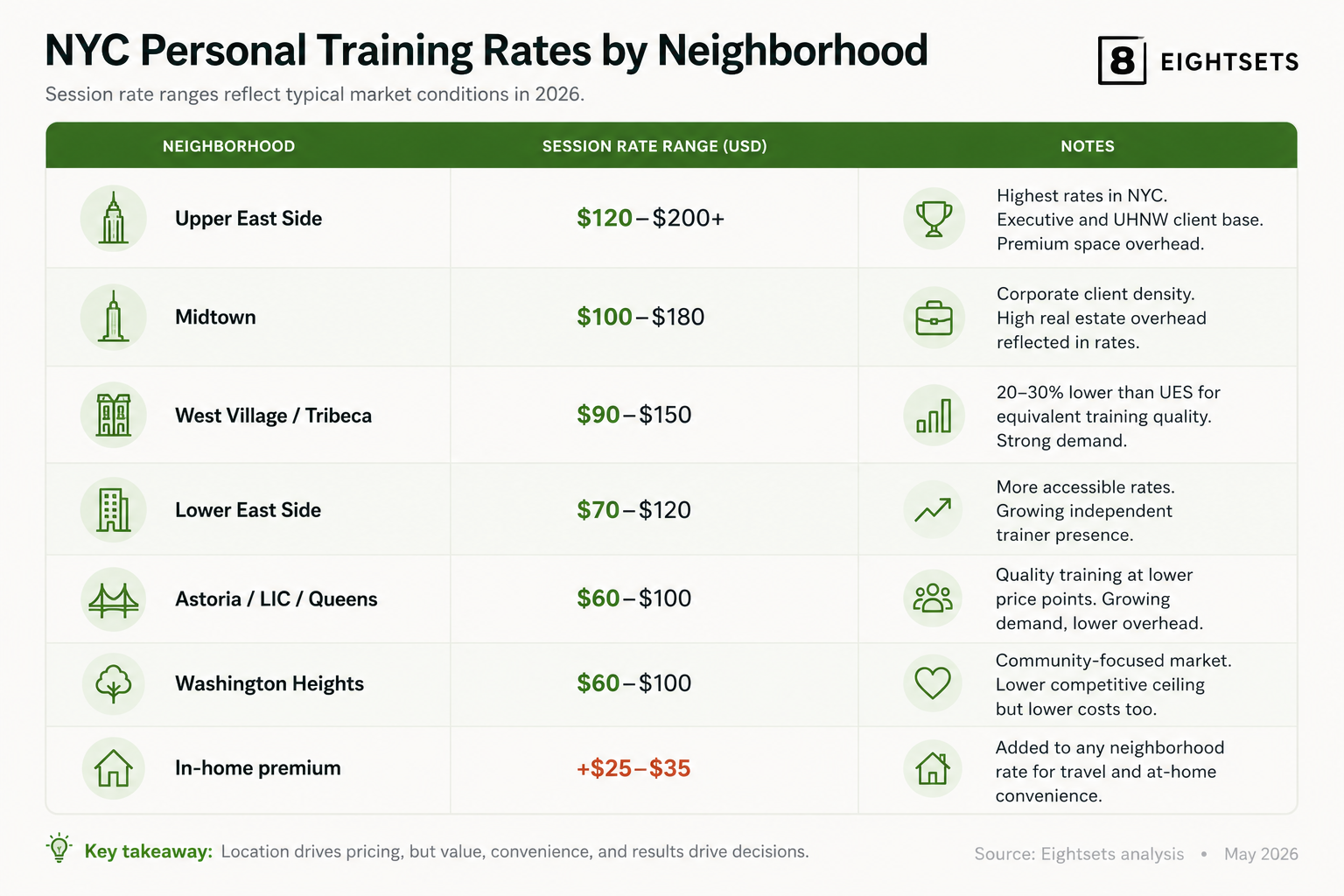
The neighborhood data reveals something important for new independent trainers: studios in Hell's Kitchen, parts of Midtown West, and east of Lexington tend to charge 20 to 30% less than equivalent studios in the West Village or Upper East Side — despite the same trainer quality. Location affects what clients expect to pay, not what training quality actually costs to deliver. An independent trainer who understands that geography can make an informed decision about where to base their practice rather than defaulting to wherever the first available space happens to be.[6]
■ The NYC Independent Training Space Ecosystem
Five years ago, an independent trainer in NYC had limited options: convince a commercial gym to allow independent sessions under a revenue split, train clients in Central Park, or try to afford a private studio lease on their own. The ecosystem has changed significantly. A growing number of purpose-built independent training facilities now operate specifically to give coaches the space, flexibility, and professional environment they need without the overhead of owning a gym.[7]
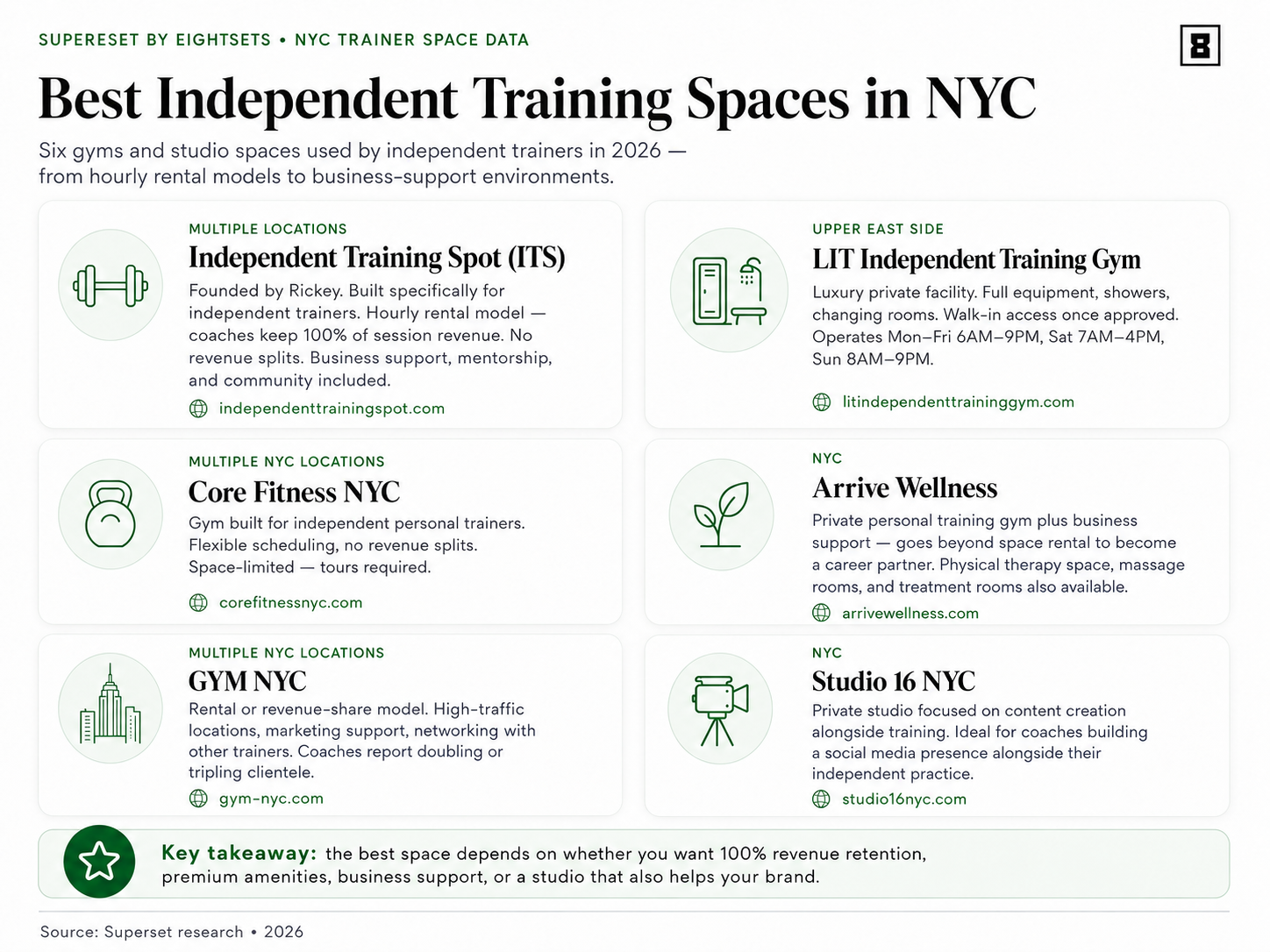
■ The Three Space Rental Models — and What Each One Costs You
Not all independent training spaces operate the same way. The model you choose has a direct impact on how much you earn, how much risk you carry, and at what volume of sessions the math works in your favor.
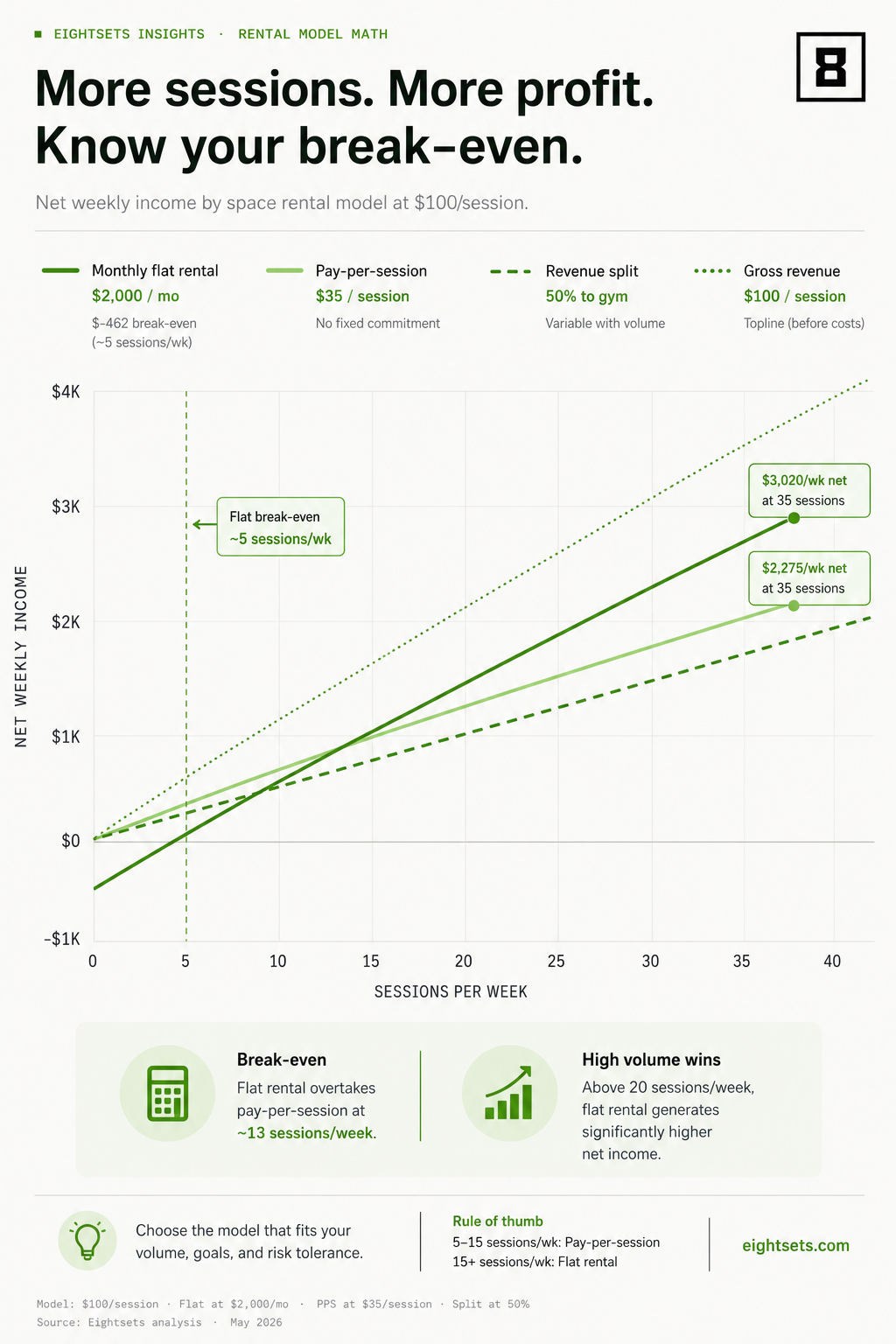
The revenue split model deserves special attention because it is the most common entry point for new independents — and the one that most limits income growth. A gym that takes 40 to 70% of your earnings means you only make $30 to $60 of a $100 session — similar to what employed gym trainers earn, without any of the employed benefits. You carry the business risk of an independent and the income ceiling of an employee. That combination is the worst of both worlds, and it is the model most commonly offered to trainers without enough leverage to negotiate otherwise.[1]
"Most new independent trainers go wrong by undercharging because they are still thinking like employees. You are not just getting paid for your time. You are running a business."
■ The Real Cost Structure of an Independent Practice
The session rate is only half the equation. Independent coaches carry business costs that employed trainers never see on their pay stubs. Understanding those costs is the starting point for any rational pricing decision.
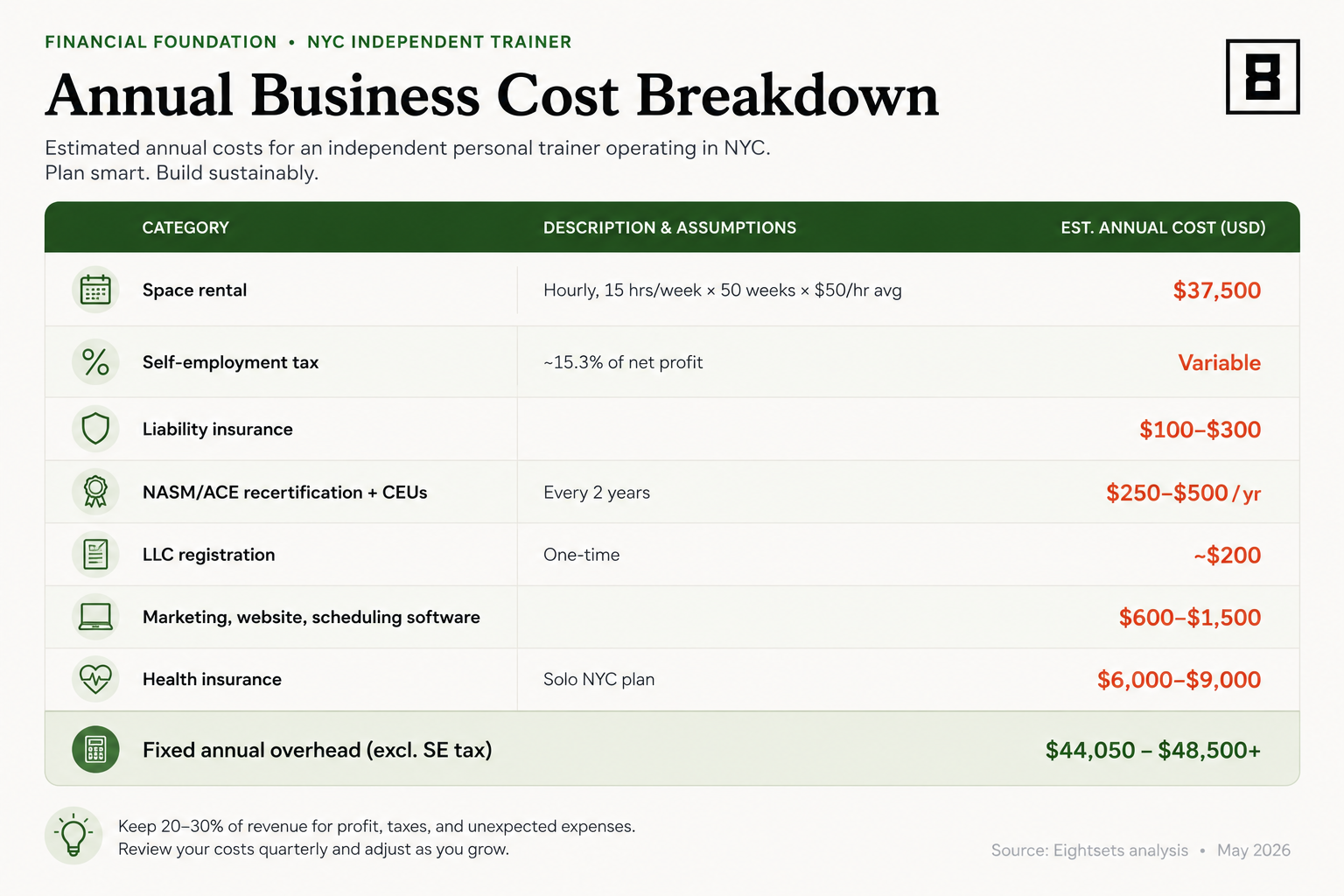
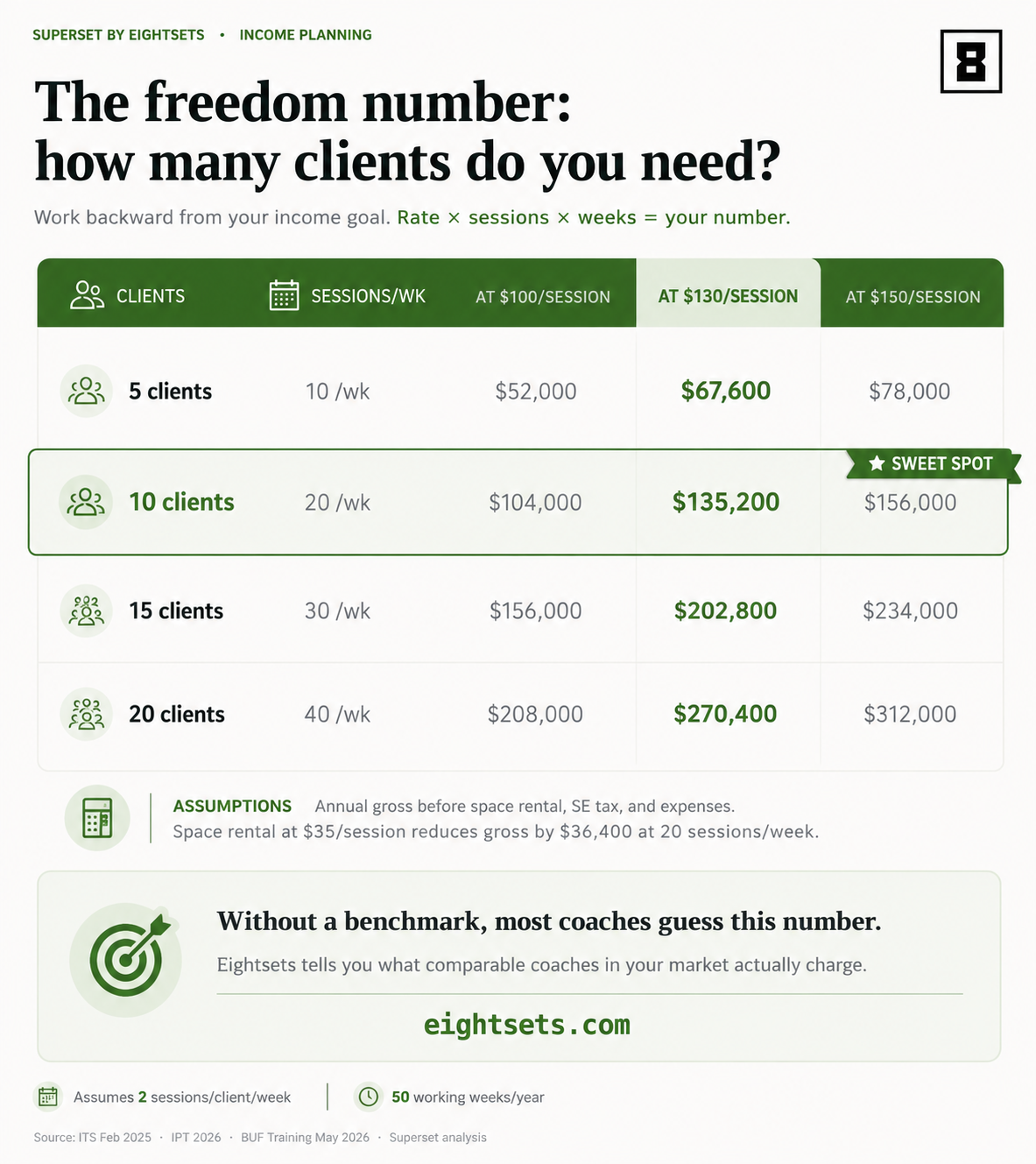
That overhead number is the starting point for any serious pricing conversation. The right framework is the "freedom number" — the total income you need each month to survive and thrive, including all business expenses, then working backward to how many sessions you need at your target rate to hit that number without burning out.[8]
Here is what that math looks like across three realistic scenarios for a NYC independent trainer charging $100 per session, after space rental of $30 per hour.
A stable base of 15 to 25 recurring clients provides solid full-time income for an independent trainer. Each client training two to three times weekly creates 30 to 75 weekly sessions. At $100 per session and 40 weekly sessions, the gross income exceeds $200,000 before taxes. That ceiling is real — but so is the work required to get there, and the gap between where most coaches start and where they need to be to cover NYC's cost of living without financial stress.[2]
■ The Specialization Premium — What It Is Worth in Real Numbers
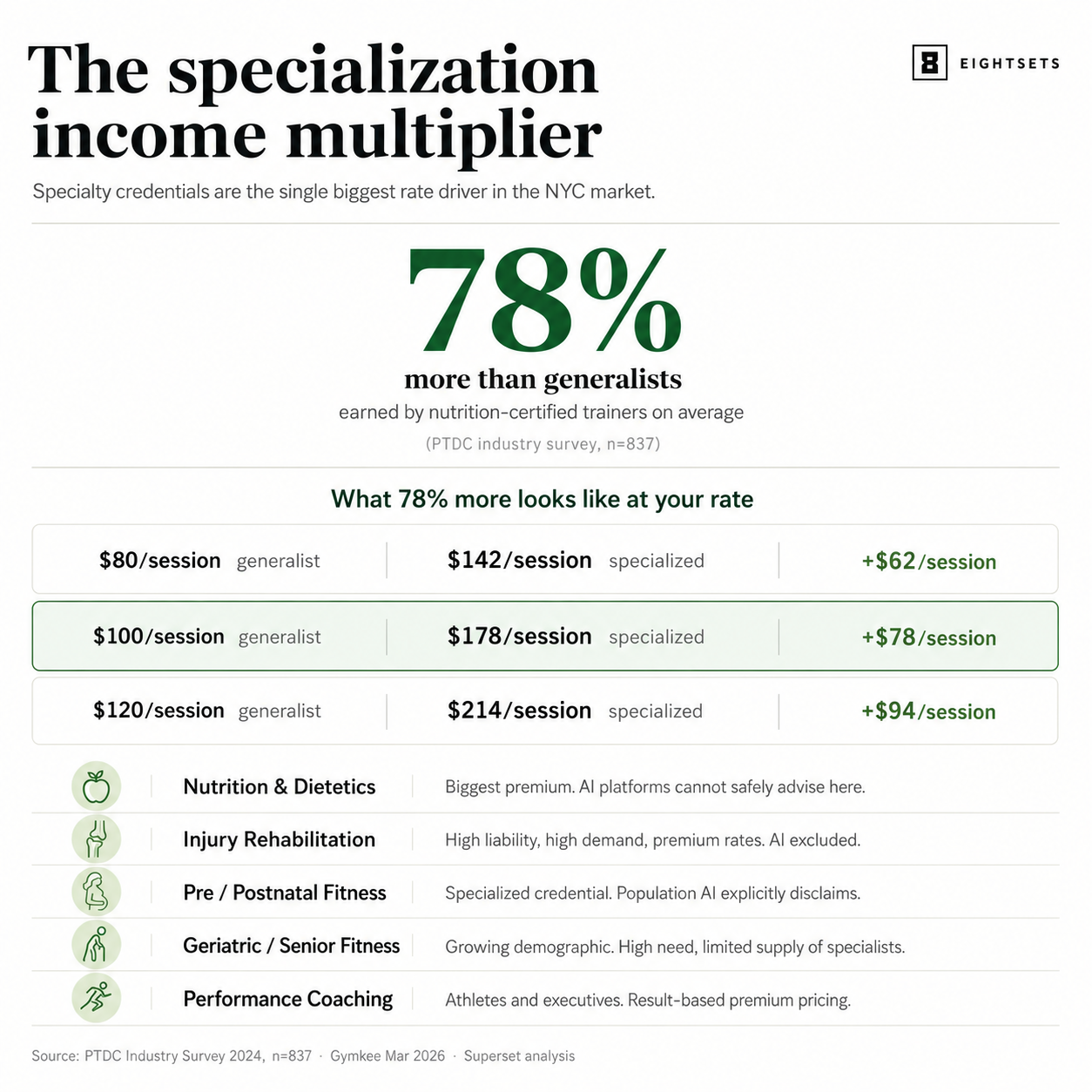
One of the most actionable findings in the independent training research is the size of the specialization premium. According to the PTDC industry survey of 837 trainers, nutrition-certified coaches earn 78% more than generalists on average. That is not a marginal premium. At a $100 per session baseline, 78% more means $178 per session — a $78 difference that compounds across every session, every client, every week.[4]
The specializations that carry the clearest rate premium in the NYC market are those that AI coaching platforms explicitly cannot safely serve — injury rehabilitation, pre and postnatal fitness, geriatric training, and performance coaching for specific sports. These populations require human expertise, professional liability, and real-time physical judgment that no wearable or language model can replicate. A coach with a corrective exercise specialization and a working relationship with physical therapy practices in their neighborhood is not competing with Google Health Coach. They are operating in a lane that AI explicitly disclaims.
Superset covered the AI coaching landscape in depth in The Data Gap. The relevant finding for independent trainers: setting matters significantly — home training commands a 20 to 40% premium over gym-based sessions due to travel time and convenience, and specialization is the single biggest income multiplier in the market.[4] Independent coaches have full control over both variables. Employed coaches control neither.
■ Why Eightsets Changes the Math for Independent Coaches
Everything above, the rate tiers, the neighborhood data, the space costs, and the specialization premium, is general market intelligence. It tells a coach roughly where to aim. What it cannot tell them is where their specific rate, in their specific neighborhood, serving their specific client demographic, actually sits relative to what comparable coaches are charging.
That is the information gap that defines the independent training market in NYC right now. And it is the gap that Eightsets is built to close.
Consider what a benchmark would mean for an independent coach making three specific decisions:
Setting the initial rate. A newly independent coach leaving Equinox has no reliable data point for what comparable trainers are charging at independent studios in their neighborhood. They might underprice out of fear, leaving money on the table permanently — because initial rates are sticky and raising them requires a client conversation most trainers avoid. A benchmark showing that comparable coaches in their neighborhood are charging $120 to $140 per session gives them the confidence to price correctly from the start.
Deciding when and how much to raise rates. Inflation has eroded 19% of purchasing power since 2022. A trainer who has not raised rates in three years has effectively taken a significant pay cut while their expenses — space rental, insurance, certifications — have continued rising. Knowing where their current rate sits relative to the market makes the raise conversation easier and the amount defensible: "comparable coaches in this neighborhood are charging this much, and I have not updated my rates since 2022."
Evaluating a space rental deal. An independent trainer considering signing a monthly flat rental at $2,000 per month needs to know whether their current or projected session rate and client volume justifies that commitment. Market data on what comparable coaches are charging — and whether that rate supports the overhead — turns a gut-feel business decision into a data-driven one.
The Eightsets benchmark does not just help coaches know what they are worth in the abstract. It gives them the specific, verifiable market data that turns every one of those conversations from anxiety-driven guesswork into a confident, informed position.
And here is the compounding benefit that is specific to independent coaches. Unlike employed trainers whose rates are set by their employer and adjusted infrequently, independent coaches set their own rates and revisit them regularly. Every six months, every new client onboarding, every conversation about raising prices — the benchmark is relevant. That makes the Eightsets dataset more valuable to independent coaches than to any other segment in the fitness industry, and it makes independent coach submissions some of the most valuable data in the system.
■ What to Watch
Whether flexible space supply keeps up with independent trainer demand. The growth of purpose-built independent training spaces in NYC has been significant — but the city's commercial real estate market is expensive and competitive. If the supply of affordable hourly training spaces does not keep pace with the number of coaches leaving commercial gyms, space rental costs will rise and compress the income advantage of going independent. Watch for new facility openings and rental rate changes at existing spaces.
Whether AI tools accelerate or slow the move to independence. Superset covered this in The Data Gap — AI handles the back-end of coaching more efficiently than any individual trainer could alone. Coaches who use AI to manage programming, client communications, and progress tracking can serve more clients with less administrative overhead, making the economics of independence more favorable at lower client volumes. The trainer who builds an independent practice with AI as a business tool — not a competitor — has a structurally stronger business than the one who does not.
Eightsets independent trainer data. As submissions from independent coaches grow, Superset will publish the first public analysis of session rates by neighborhood, specialization, and training format for NYC's independent market. That data will be the most practically useful thing Superset has ever published — and it only exists if independent coaches submit.
Sources & references
- [1]NYC Gym Rental Costs for Personal Trainers 2025 Guide — Independent Training Spot (ITS), Feb 2025 (pay-per-session $20–$50, monthly $1,500–$3,000, revenue split 40–70%)
- [2]How Many Clients Do Personal Trainers Need in NYC? — ITS, Feb 2025 (30–50% gym cut; 15–25 clients for full-time)
- [3]How Much Does Personal Training Cost in NYC? 2026 Pricing Guide — BUF Training, May 2026 (tier breakdown; neighborhood premiums)
- [4]Personal Training Rates in 2026: By City, Setting, and Specialty — Gymkee, Mar 2026 (78% specialization premium; 19% inflation erosion; NYC $100–$200/hr)
- [5]Cost of Personal Training in Manhattan: 2026 Rates — Manhattan Personal Training (neighborhood rate breakdown)
- [6]Hell's Kitchen / Midtown West 20–30% lower than UES — BUF Training, May 2026
- [7]Independent Gym Space NYC: How to Choose the Right One — ITS, Mar 2025 (space ecosystem, trainer-friendly policies)
- [8]How to Become an Independent Personal Trainer in NYC — ITS, Apr 2025 (freedom number framework; 30–90 day transition plan)
- [9]Independent Personal Trainer NYC Requirements — ITS, May 2025 (liability insurance $180/yr; LLC; contracts)
- [10]Personal Trainer Cost NYC: Complete 2025 Rate Breakdown — Alex Folacci ($400/hr high end; Equinox $120–$200)
- [11]Is Personal Training a Good Side Hustle in NYC? — ITS, Jul 2025 ($75–$150/hr certified independent; 5 clients changes finances)
- [12]Personal Trainer Salary Guide 2025 — ISSA (employment model comparison; independent vs employed income)
- [13]How Much Do Personal Trainers Make Annually in 2025/26? — IPT (15–25 recurring clients for full-time; 40 sessions/week $100 = $208K)
- [14]How Much Does Personal Training Cost in Manhattan? — Type A Training, Feb 2026 ($75–$150 independent; Business Insider data)
Member discussion