The Community Economy: Is Hyrox Building a Better Business for Coaches or Just a Better Brand?

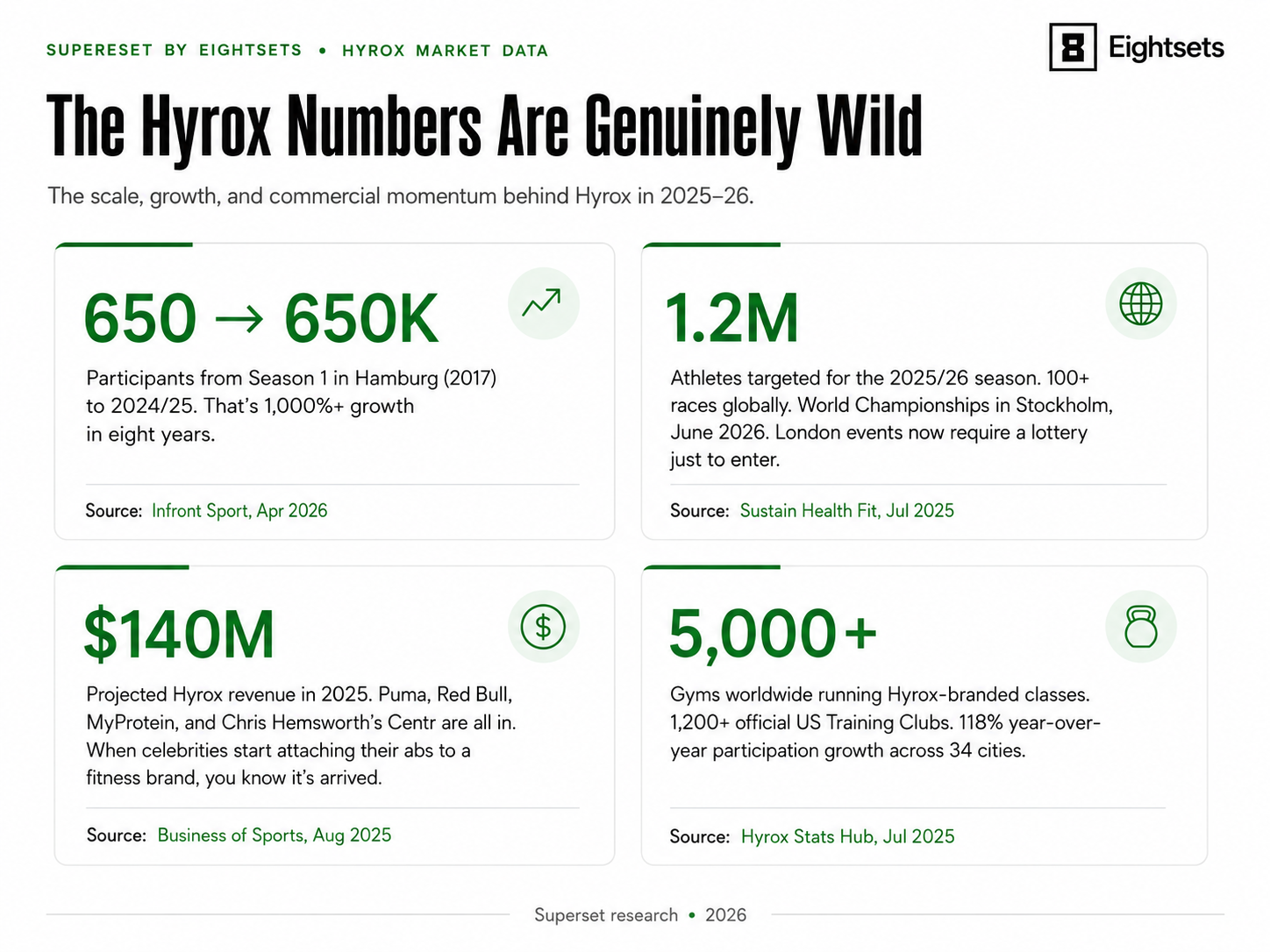
650 participants in Hamburg. 650,000 athletes worldwide. A certification ecosystem, a $140M business, and a waiting list for race tickets. Hyrox is unambiguously one of the biggest developments in fitness in a decade. But before you spend money on the credential, the community, and the model, Superset has some questions worth sitting with first.
Let's start with the wall balls.
Ninety minutes into a Hyrox race. Eight kilometers of running under your belt. Your legs have filed a formal complaint. The DJ is playing something that shouldn't work but absolutely does. And you're throwing a medicine ball against a wall target while strangers cheer you like you're finishing an actual marathon.
Here's the stat that tells you everything: 70% of Hyrox participants purchase the official race photo package afterward. Seventy percent. That's not a fitness metric. That's a feelings metric. And it's the most important number in this entire piece.
Because what Hyrox is selling and what the community training model broadly is selling—isn't a workout. It's a feeling of belonging to something. That's the business that coaches are being invited into. And it's genuinely worth examining whether that invitation comes with good terms.
Superset's take: the community training model has real structural advantages that deserve credit. The Hyrox certification ecosystem deserves scrutiny. And the income question—whether any of this actually pays coaches better—remains wide open because the data doesn't exist yet.
That's the honest version. Let's get into it.
WHAT HYROX ACTUALLY BUILT (AND WHY IT MATTERS)
Here's the thing about Hyrox's workout format: it's not revolutionary. Eight one-kilometer runs alternated with functional fitness stations—sled push, ski erg, rowing, wall balls. Well-designed. Accessible. But not a reinvention of exercise.
The revolution is the finish line.
For the first time, millions of people who train every day had a race built for them. Not just for runners. Not just for CrossFit athletes. For everyone who shows up and puts in the work.[1]
That distinction is enormous for coaches. A client training for a Hyrox race in October doesn't skip Monday's session because it's raining. They don't quietly cancel when life gets complicated. They have a bib number, a registered start time, and a community of people who will absolutely ask how it went.
The coach gets to ride that motivation without creating it. That's a meaningful structural advantage over asking a client to "stay consistent" and hoping for the best.
Hyrox now operates as a year-round fitness ecosystem that influences how athletes train, how gyms program, and how communities form around shared goals.[2] Translation: coaches affiliated with Hyrox aren't just selling sessions. They're selling ongoing membership in something with a recurring external deadline. That's a fundamentally better business model than "let's see how you feel next month."
THE NYC COMMUNITY TRAINING ECOSYSTEM
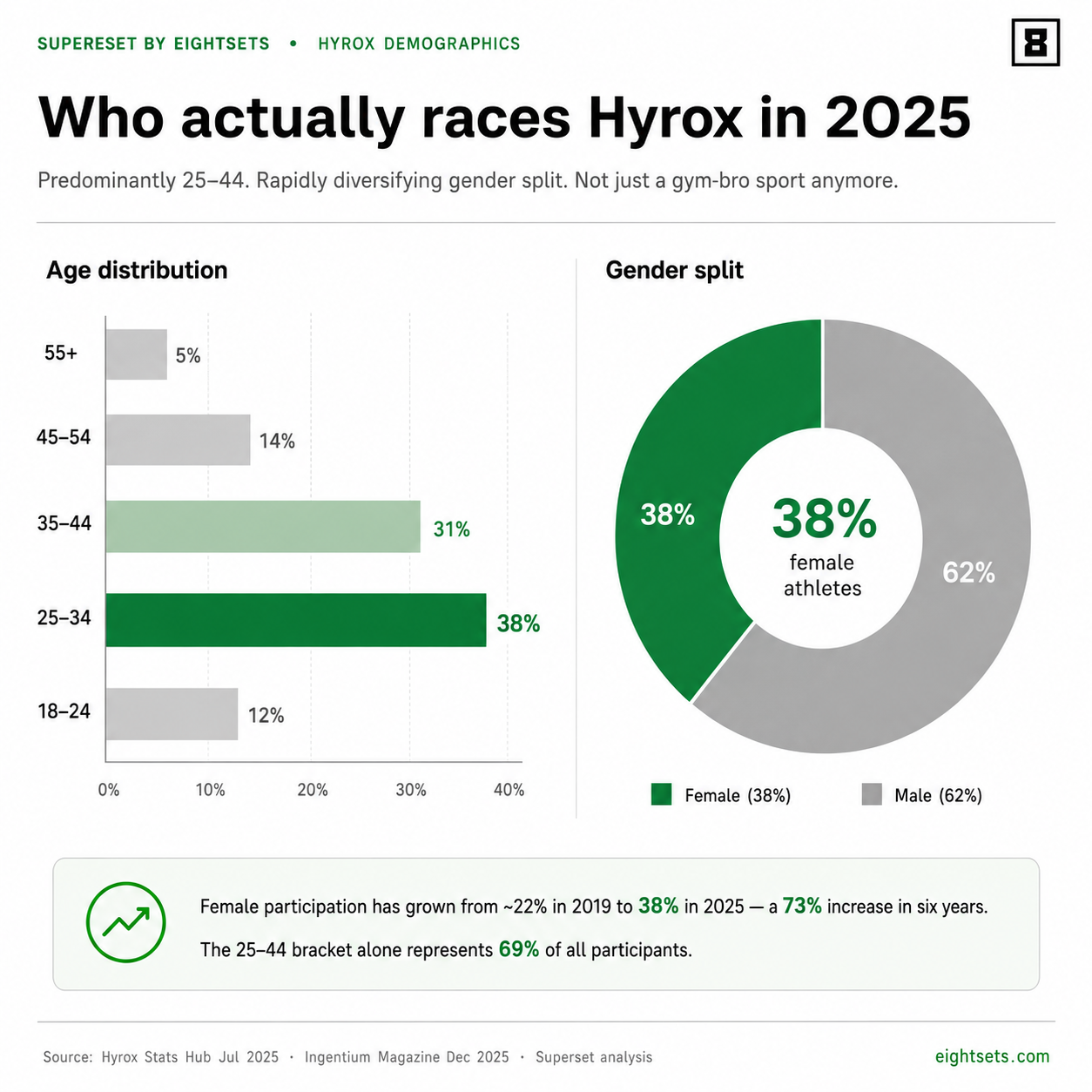
New York has its own version of this conversation playing out in real time. A handful of studios have built the community model into their DNA—and they are not all the same thing.
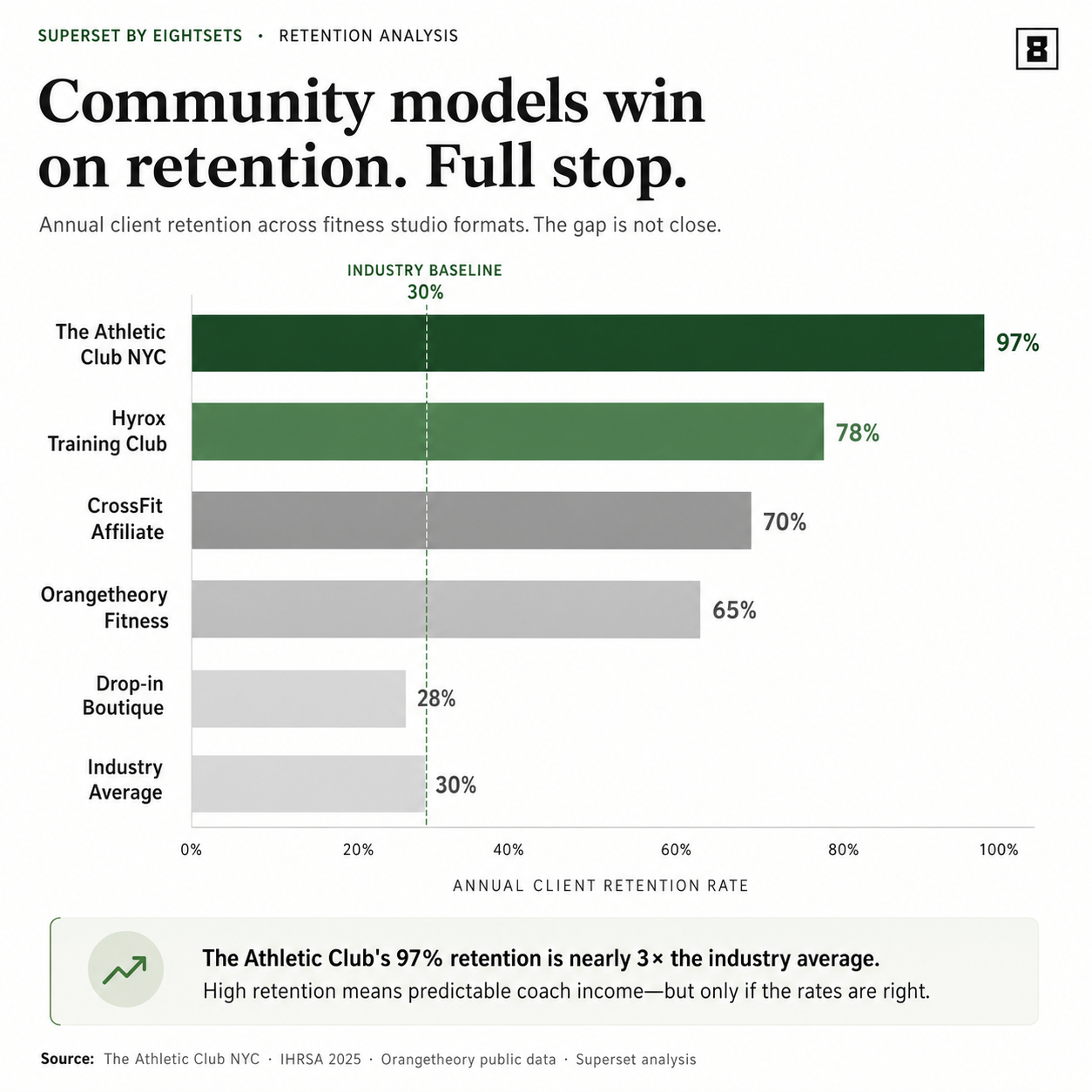
The Athletic Club's 97% retention rate deserves a moment of appreciation.[3] The industry average for boutique fitness hovers somewhere around 30 to 40%. Ninety-seven is not a retention rate. That's a hostage situation—in the best possible way.
The reason it works isn't mysterious. Members show up twice a week with the same squad and the same coach. That social contract is significantly harder to cancel than an app subscription. You're not ghosting a platform. You're ghosting people.
THE HYROX TRAINER CERTIFICATION—READ THIS BEFORE SPENDING MONEY
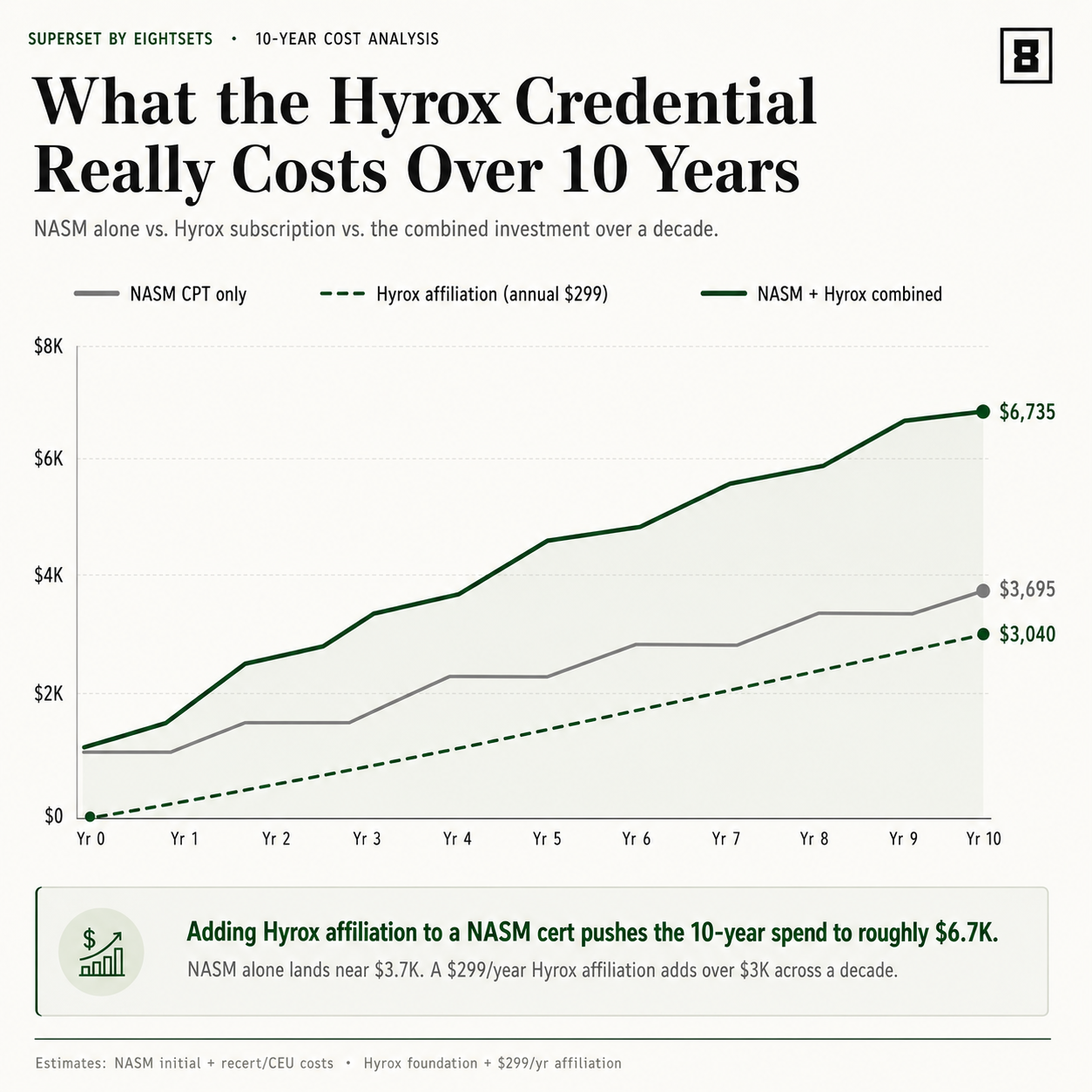
Here's where Superset earns its keep. The Hyrox certification ecosystem is being marketed aggressively at the exact moment Hyrox is at peak hype. That timing is not a coincidence. And coaches, considering the investment, deserve a clear-eyed breakdown.
We covered the fitness certification business model in The Certification Business. The pattern—mandatory recurring costs, limited independent data on ROI—shows up here too, with a twist that makes it more interesting and slightly more concerning.
THE NCCA PROBLEM—SHORT VERSION
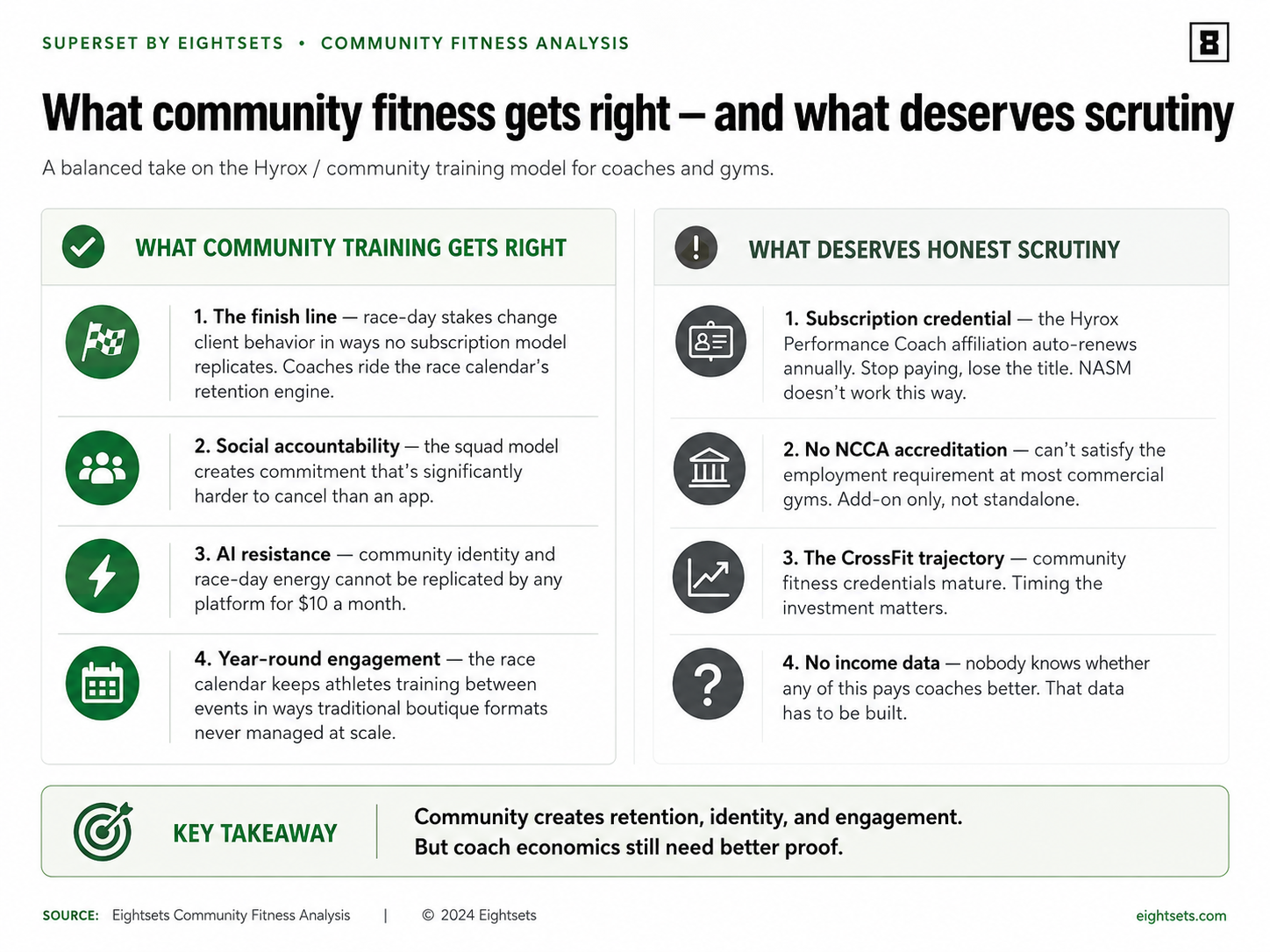
The Hyrox Performance Coach credential is not currently NCCA-accredited.
We covered NCCA accreditation in The Certification Business. The short version: nearly every major commercial gym requires it for employment. Equinox. LA Fitness. Life Time. Most corporate fitness operators. NASM, ACE, and NSCA all have it. Hyrox does not.
What this means for coaches:
- The Hyrox cert works brilliantly if you're already independent or operating inside a Hyrox-affiliated gym.
- It does not satisfy the employment requirement at most commercial gyms.
- As a standalone credential, it limits your options significantly.
- As an add-on to NASM or ACE, it makes a lot more sense.
This isn't an argument against Hyrox. It's an argument for knowing exactly what you're buying.
MOVEMENT OR MOMENT? THE CROSSFIT COMPARISON
Anyone evaluating the long-term value of a Hyrox credential needs to sit with the CrossFit parallel. Not as a dismissal—CrossFit is genuinely still going—but as a case study in what happens when community fitness certifications mature.
CrossFit built its affiliate network and certification pathway on exactly the same premise Hyrox is operating on now. Standardized format. Competitive event. Brand-usage credential. The CrossFit Level 1 was one of the most valuable fitness credentials in the market between 2012 and 2018. Then the market matured. The certification became more common. The premium narrowed.
Hyrox has structural advantages CrossFit didn't. Hyrox's standardized race format gives every competitor split times, stage-by-stage data, and year-over-year comparisons—making it inherently more trackable than a general functional fitness community.[4] The global race calendar creates recurring external deadlines that keep athletes engaged in ways CrossFit programming never managed at scale.
But here's the honest take: coaches who invest in the Hyrox ecosystem now—at peak growth—will benefit more from the credential's differentiation value than coaches who enter a crowded Training Club market in 2028 after the initial wave has matured. Timing this kind of investment matters as much as the investment itself.
"Hyrox didn't create a better workout. It created a better reason to show up. For coaches, those are two very different things—and only one of them compounds over time."
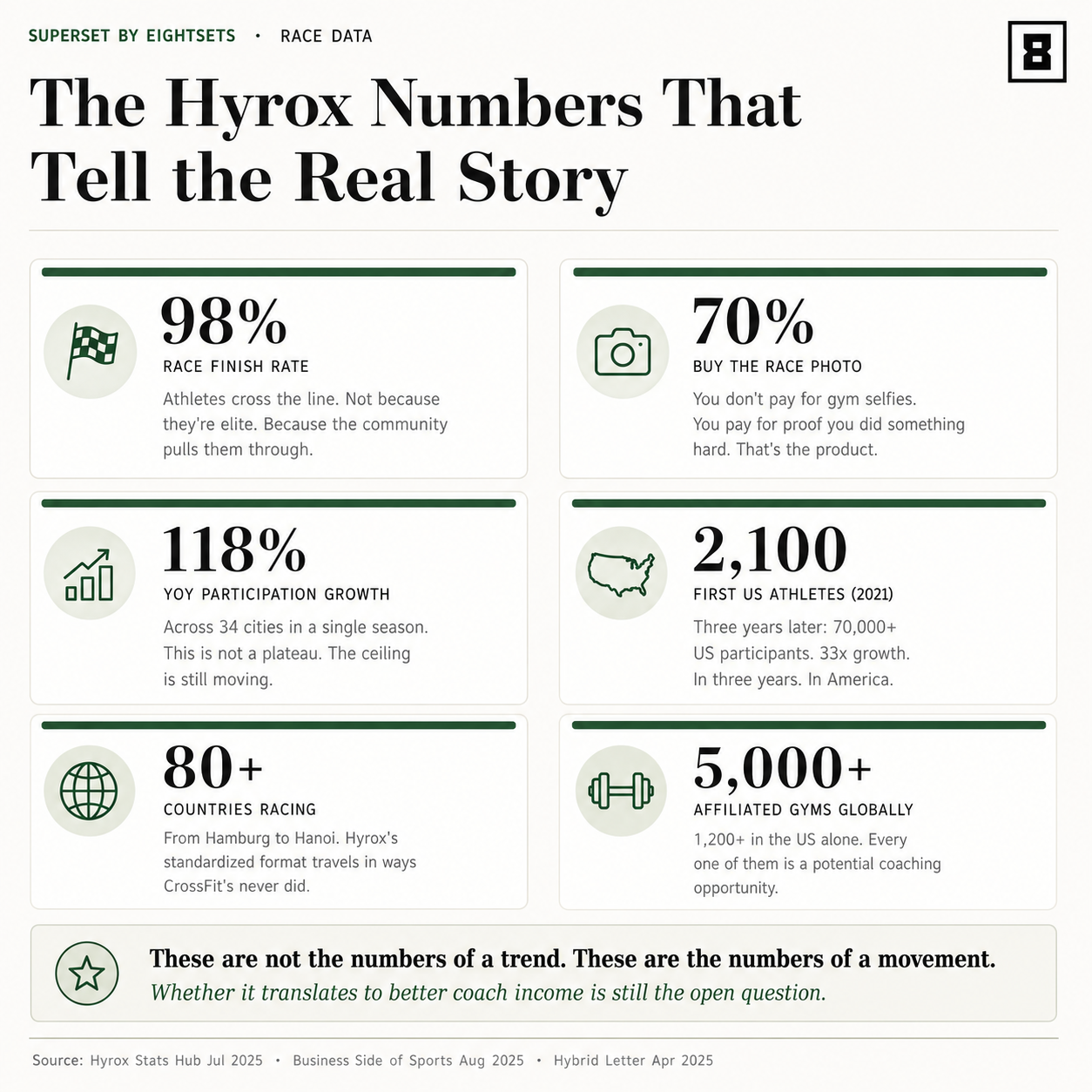
THE AI ANGLE—AND WHY COMMUNITY TRAINING WINS THIS ONE
Superset has been covering the AI coaching land grab since the beginning—five platforms in eight months, all gunning for the same baseline coaching market. If you haven't read The Data Gap, the short version is: AI is systematically displacing the services most mid-market coaches get paid for. Programming. Nutrition guidance. Progress tracking. Form assessment.
Here's what AI cannot do: put you in a room full of people who will judge you if you don't show up on Saturday.
Ask anyone who has raced Hyrox what surprised them most—the answer is rarely the workout. It's the person next to them pushing through wall balls while the crowd cheers.[1]
Google Health Coach knows your client's resting heart rate, sleep score, and last three lab results. It does not know they're going to a Hyrox race in six weeks with their office run club and they absolutely cannot finish last.
That accountability is not built by a coach or an app. It's built by belonging to something. Community training is one of the most structurally defensible niches in fitness against AI disruption—and that's worth saying clearly.
The question is whether that structural advantage actually reaches coaches in their pay. Which brings us to the part that's frustrating to write.
THE INCOME QUESTION NOBODY CAN ANSWER (YET)
Do community-based coaches and Hyrox-certified trainers actually earn more than their peers in traditional formats?
We don't know. And neither does anyone else.
Here's what we can say:
- The Athletic Club's 97% retention means coaches inside that model have more predictable income than boutique instructors paid per class—because high retention means consistent volume.
- Consistent volume is not the same as better rates. A coach with stable income at a below-market rate is more financially secure, but they're still leaving money on the table.
- The community model's income advantage is only real if the rates inside it reflect the value being delivered. And right now, no public data exists to evaluate whether they do.
Is a Hyrox Performance Coach in New York charging more per session than an equivalent independent trainer without the credential? Does the annual subscription cost justify itself in actual rate premium? Do Athletic Club coaches out-earn Tone House coaches serving the same client demographic?
Every one of those questions matters. None of them have public answers. That is exactly the information gap Eightsets exists to close.
THE BOTTOM LINE
Superset isn't telling coaches to avoid Hyrox or community training. The case for the model is genuinely strong. The race-calendar retention engine, the AI resistance, the year-round engagement—all real competitive advantages.
The Hyrox certification? The Level 1 course content is substantive and worth the time. The subscription commercial structure is worth understanding before you commit. The NCCA gap is worth knowing before you build a career around a single credential.
And if you're already coaching inside the community training model—at Tone House, the Athletic Club, a Hyrox Training Club, or anything similar—your compensation data is some of the most underrepresented and most needed information in the Eightsets dataset. The question of whether community training actually pays better can only be answered when coaches inside it submit their numbers alongside coaches who aren't.
No public benchmark exists for Hyrox Performance Coach rates, Athletic Club pay, or Tone House compensation. If you work in community-based training in any format, in any city, your data is what answers the question this article couldn't.
Submit anonymously at Eightsets.
Two minutes. No names. And the more community coaches who submit, the closer we get to the honest income picture this model deserves.
WHAT TO WATCH
NCCA accreditation status. If Hyrox pursues and achieves NCCA accreditation, the Performance Coach credential becomes a serious employment currency at commercial gyms and the investment case gets considerably stronger. Watch this space closely.
Whether participation holds above one million. The 2025/26 season is targeting 1.2 million athletes.[6] Whether that target lands—and what the growth curve looks like after it—will tell coaches a great deal about whether this follows a CrossFit maturation arc or builds something more durable.
Eightsets community training data. As submissions from coaches at Hyrox Training Clubs and community studios grow, Superset will publish the first public analysis of whether community-based training pays coaches better, worse, or just differently. The analysis only exists if the coaches in this space choose to be counted.
The community training economy is real. Hyrox's growth story is extraordinary. The finish line effect is one of the smartest things fitness has done in years.
Whether it's building better businesses for coaches—or just better branding for everyone else—is the question only the data can answer.
Superset will be here when it does.
Sources & references
- [1]Why the Hyrox Community Keeps Growing — Hyrox Benelux, Mar 2026
- [2]Hyrox: From Disruptive Race to Global Powerhouse — Infront Sport, Apr 2026
- [3]The Athletic Club NYC — 97% client retention — via Zippia coach listings, May 2026
- [4]The Explosion of Hyrox, in One Chart — The Hybrid Letter, Apr 2025
- [5]Skyrocketing Demand for Hyrox Fitness Competitions — Business Side of Sports, Aug 2025
- [6]Hyrox Expands 2025/26 Calendar with 47 New Races — Sustainhealth Fit, Jul 2025
- [7]Hyrox365 Level 1 Course — Hyrox365 Academy
- [8]Hyrox Performance Coach Affiliation — Hyrox365.com
- [9]The Hyrox Foundation Course — My Experience — Garage Gym Revisited, Oct 2025
- [10]How to Become a Hyrox Coach — OriGym, Jan 2026
- [11]Hyrox: The New Fitness Competition Sweeping the World — Cigna Global, Jun 2025
- [12]Hyrox Participation Trends Among 275,000 Athletes — Ingentium Magazine, Dec 2025
- [13]About Tone House — tonehouse.com
- [14]Hyrox Stats Hub — Gym Flooring, Jul 2025
Member discussion