The Data Gap: AI Coaches Now Know More About Your Clients Than You Do
Google just launched an AI personal trainer that reads your client's medical records, tracks their heart rhythm, analyzes their sleep, and can identify gym equipment from a photo. Five platforms in eight months. The AI coach data advantage is real — and growing. Here is what human coaches need to understand, and exactly what to do about it.
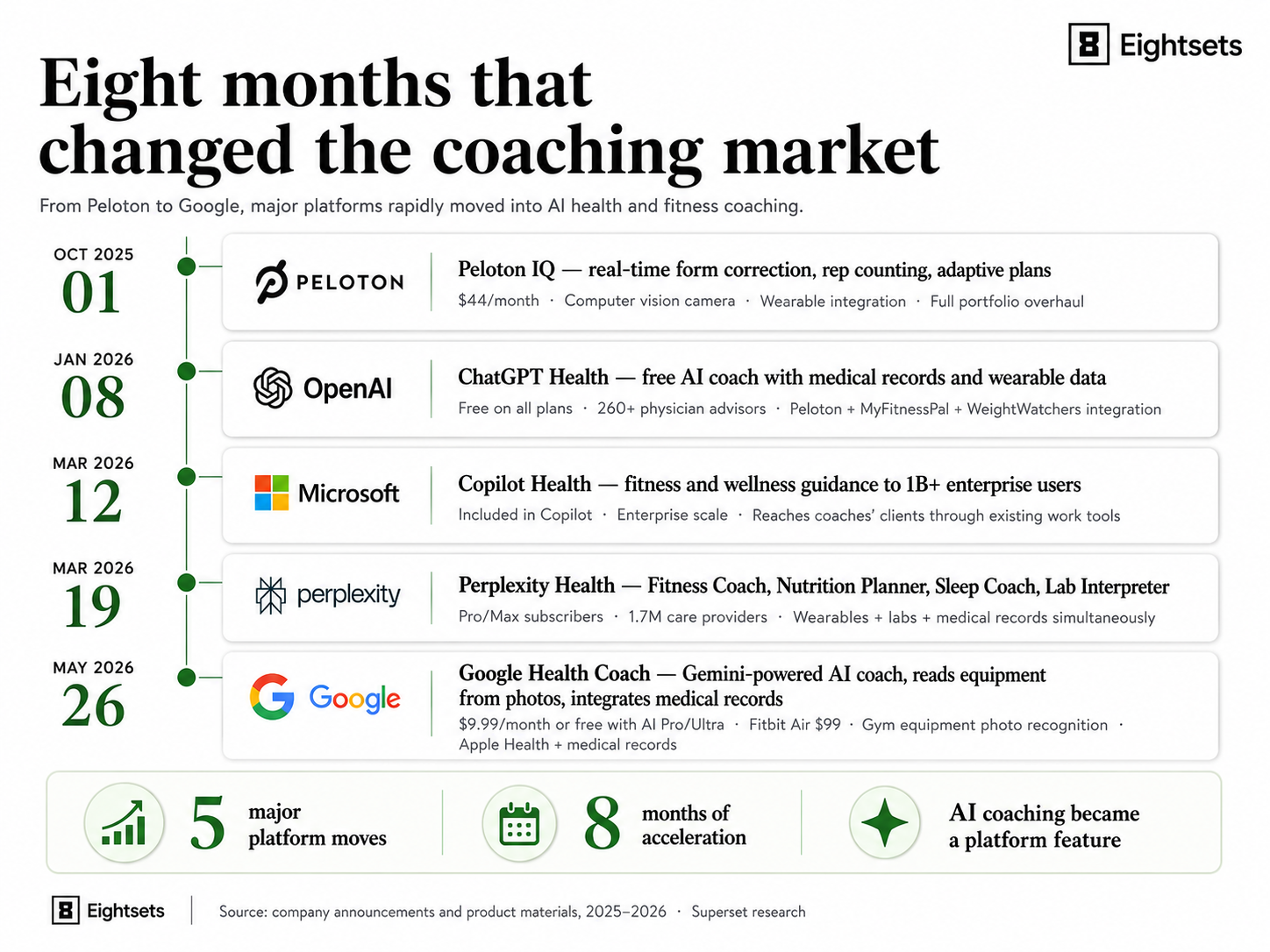
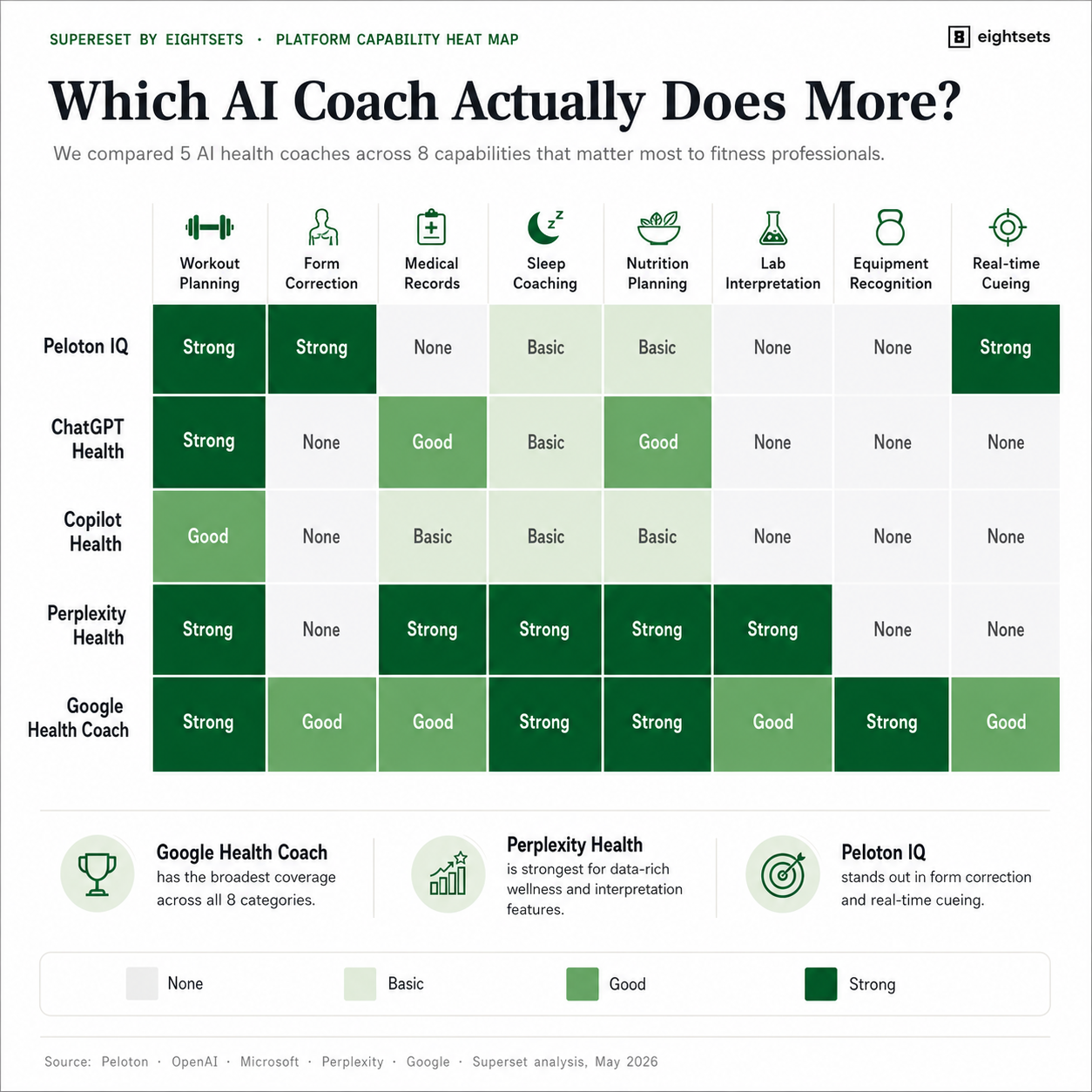
When Superset published The Land Grab in April, we documented four AI fitness coaching platforms that launched in six months. Peloton IQ, ChatGPT Health, Microsoft Copilot Health, Perplexity Health. The argument was that Big Tech had declared coaching a feature, not a profession, and that the coaches most at risk were the ones who hadn't noticed yet.
That was four weeks ago. On May 7, 2026, Google launched the Fitbit Air and Google Health Coach — a Gemini-powered AI personal trainer, sleep coach, and health advisor available globally starting May 26, included with Google Health Premium at $9.99 per month.[1] That makes five AI personal trainer products from five of the most powerful technology companies in the world, launched within eight months of each other.
But the Google launch is not just another entry to add to the timeline. It introduces something qualitatively different from what came before. The AI personal trainer strategy problem for human coaches is no longer about competing with a program generator. It is about competing with a coaching system that has access to data most human coaches will never see.
This article covers what that data advantage actually is, why it matters for human coaches specifically, and — critically — exactly what coaches need to do about it. This is the piece The Land Grab pointed toward. It is also the piece that connects most directly to why the work Eightsets is doing matters more now than it did twelve months ago.
■ What Google's AI Coach Actually Does — and Why It Changes the Conversation
The Google Health Coach is not meaningfully different from its predecessors in most respects. It generates personalized workout plans, analyzes sleep, offers nutrition guidance, and integrates health data from wearables and medical records. That is the same architecture Perplexity, ChatGPT, and Copilot are running — personal health data feeding into coaching recommendations through a conversational interface.[2]
What is genuinely new is one feature: with Google Health Coach, a client can snap a photo of the cardio equipment in front of them, or the circuit training routine written on the whiteboard at their gym, and the AI will build a plan from it.[3] That is not program generation. That is environmental analysis — real-time reading of the physical coaching context. The AI is no longer just asking what your goals are. It is observing your surroundings.
That feature is worth pausing on. The initial assessment — understanding a client's current environment, available equipment, and physical context — is one of the foundational competencies personal trainers are trained and certified to perform. Google has built a version of it into a $99 device and a $10 monthly subscription.
And then there is the data. The Google Health Coach integrates: Fitbit and Pixel Watch wearable data, Apple Health, Health Connect, medical records including lab results and vitals, Peloton activity data, and MyFitnessPal nutrition logs. The coach has a continuous, integrated view of a client's health that most personal trainers will never have access to — even for clients they have worked with for years.
"Your client's AI coach knows their resting heart rate, history, sleep quality, and last three lab results. You know what they tell you in the first five minutes of a session. That is the data asymmetry human coaches are now operating inside."
■ The Data Asymmetry Problem — Mapped Honestly
Before getting to strategy, it helps to be precise about what AI coaching platforms actually have access to, versus what human coaches typically know about their clients. The gap is larger than most coaches have acknowledged.
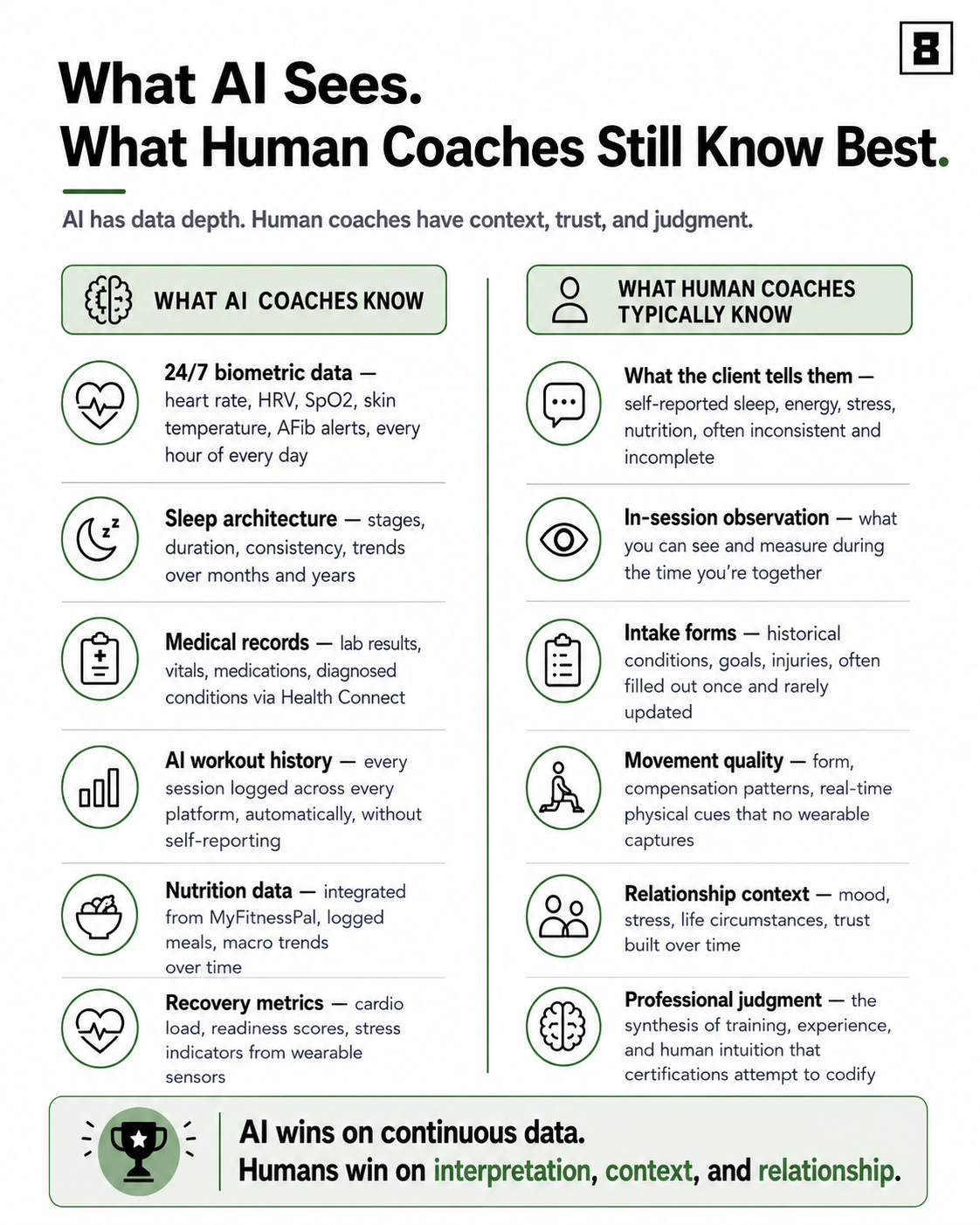
The AI column is growing every month as wearables become more sophisticated and health data integrations expand. The human column is not shrinking — but it is not growing either, and the gap in data access between the two is widening with each new platform launch.
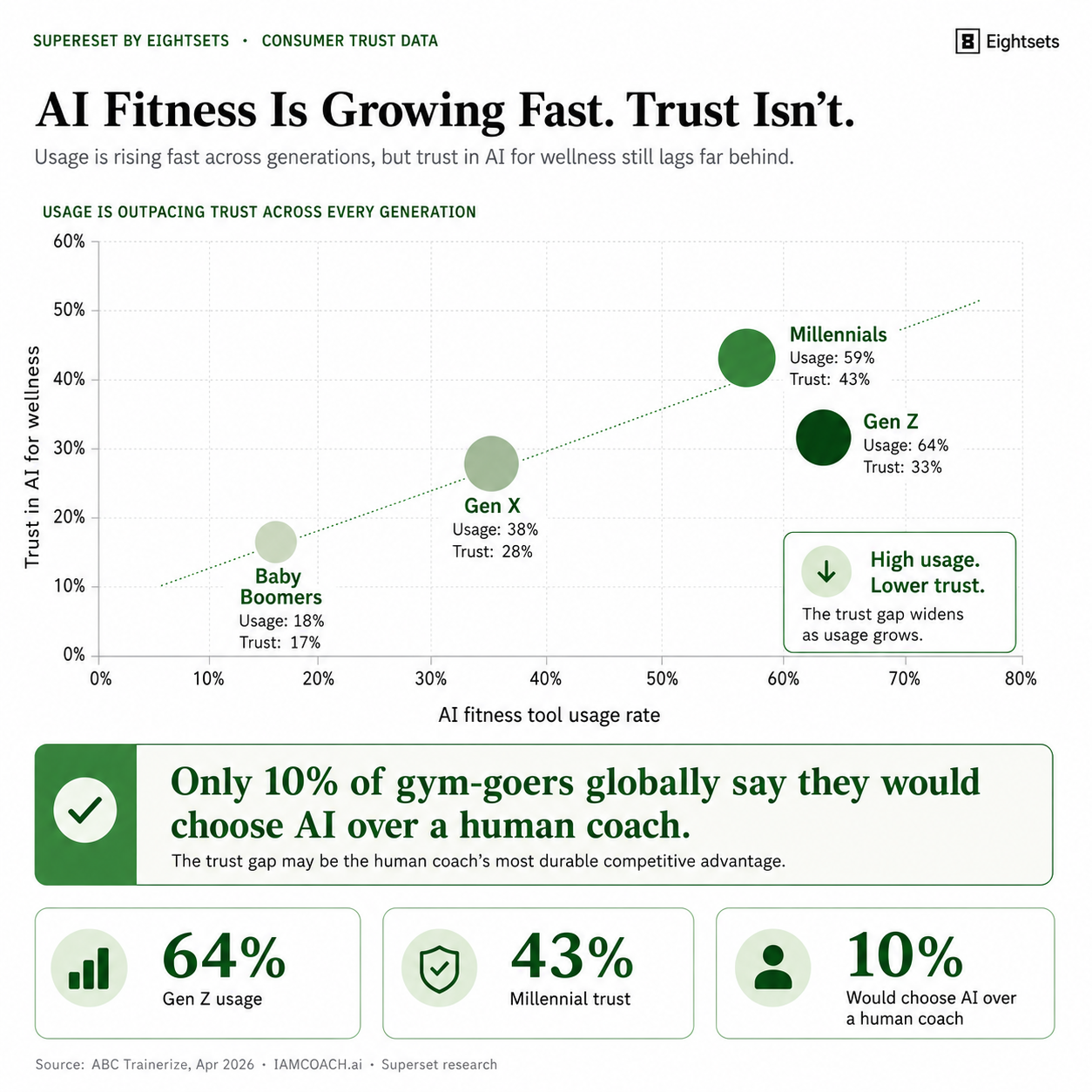
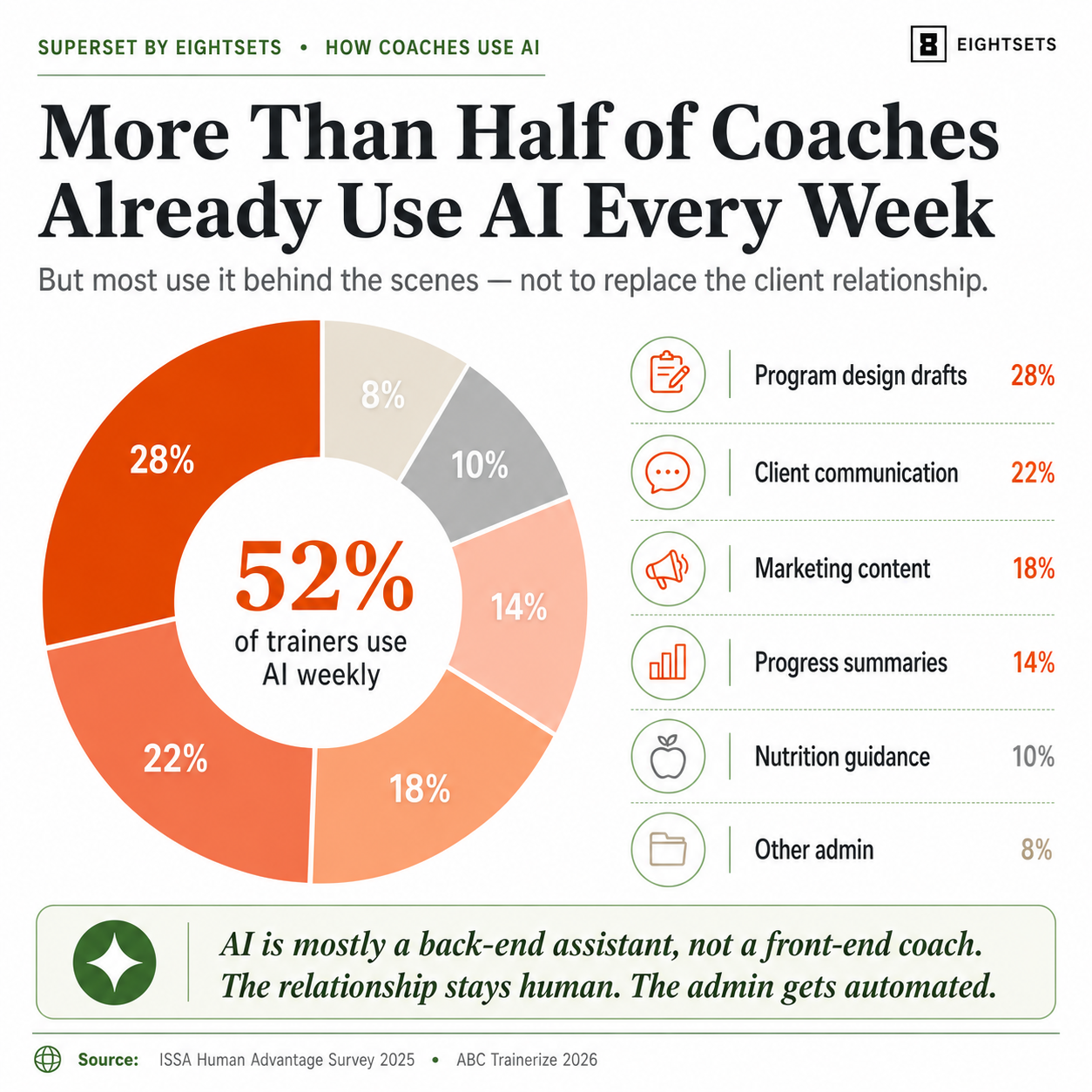
The strategic implication is not that human coaches are losing. ISSA's 2025 Human Advantage survey found that 64% of certified trainers report their clients have not even raised AI as a coaching topic.[4] Only 10% of consumers globally say they would prefer AI to a human coach.[5] The coaching profession is not under immediate existential threat. The strategic implication is that human coaches who understand the data gap — and who build their value proposition accordingly — will be increasingly difficult to replace. Those who do not will be competing with a $10 monthly subscription and losing clients without knowing why.
■ What AI Cannot Do — and Why That Is Your Business
This section matters because the coaching industry's response to AI has largely been vague reassurance. "AI can't replace the human connection." That is true, but it is not a strategy. Here is the specific, evidence-based version of what AI coaching cannot do, and how to price for it.
A meta-analysis published in Health Psychology Review found that social support and accountability from a human coach increased exercise adherence by 27% compared to self-directed programs.[6] A client can ghost an AI program without consequence. They cannot ghost you without a conversation. That accountability relationship, the reason a client shows up at 6 AM on a Tuesday when they would rather stay in bed, is a specific, measurable outcome that AI platforms cannot replicate. It is also something coaches chronically underprice.
AI cannot read the room. It does not know your client had a terrible sleep or is going through a breakup. It cannot adjust a session on the fly based on energy, mood, or body language.[7] The Google Health Coach knows your client's sleep score from last night. It does not know they are crying in the parking lot before their session. Real-time emotional and physical presence is not a soft skill. It is a clinical competency that affects outcomes — and it cannot be replicated by a wearable or a language model.
AI outputs still need human judgment. Every AI-generated workout plan is a draft, not a deliverable. The accuracy and safety risks are the primary concerns trainers raise about AI coaching tools.[8] An AI that recommends a deadlift progression to a client with an undiagnosed herniated disc is not a coaching error — it is a liability event. Human coaches carry professional responsibility for their programming. That accountability structure is why certified coaches are hired, why gyms require credentials, and why the managed services model Superset has documented in corporate and residential fitness exists. AI platforms explicitly disclaim that role. Human coaches own it.
The coaches who survive and thrive in an AI-saturated market will not be the ones who argue loudest that they are better than the algorithm. They will be the ones who price clearly for what they deliver that the algorithm demonstrably cannot.
■ Why Eightsets Matters More in This Environment, Not Less
Every strategy in the section above requires a coach to understand their market position clearly. Strategy 5 in particular depends on it entirely. If you do not know what comparable coaches in your market, with your specialization, serving your client demographic are charging — you cannot know whether your current rate reflects your human advantage or whether it reflects a pre-AI pricing model that is now being undercut by a $10 monthly subscription.
Here is the specific way the data gap interacts with compensation data. As AI platforms expand their capabilities, the coaches who are best positioned are the ones who can demonstrate premium value through specialization, accountability, and outcomes. Those coaches can justify higher rates. But they can only communicate that confidently if they know what the market is paying for premium coaching — and where their current rate sits relative to that benchmark.
A coach who discovers through Eightsets data that comparable coaches in their market are charging $40 more per session than they are has actionable information. They can raise their rates, improve their positioning, or both. A coach who has no benchmark is making pricing decisions in the dark — and in a market where AI is compressing the value of baseline services, pricing in the dark is increasingly dangerous.
AI-augmented trainers can support more clients without burnout — with AI handling programming and routine touchpoints, a single trainer can oversee 30 or more people while focusing on relationships.[9] That scalability advantage is real — but it only materializes for coaches who know their market well enough to position and price correctly. Scaling a business at the wrong rate does not fix the underlying problem.
The compensation benchmark Eightsets is building is not just about knowing what peers earn. In an AI-disrupted market, it becomes the foundation for the strategic decisions that determine which coaches thrive and which ones spend the next three years competing with Google for $10 a month.
In a market where AI is commoditizing baseline coaching, knowing what your human advantage is actually worth in the market is not optional information. It is the foundation of every pricing and positioning decision you make. Submit your compensation data at eightsets.com, anonymously, in two minutes.
The benchmark only works if you are in it. And in this environment, not having that data is the most expensive mistake a coach can make.
■ What to Watch
Whether Apple enters the space. Apple scaled back its AI health coach project "Mulberry" in early February 2026 due to FDA concerns and reliability issues — not because the technology did not work. Apple's eventual entry into AI coaching, when it comes, will arrive with the largest existing wearable ecosystem of any company in this list. Watch for WWDC announcements.[10]
Whether gym chains accelerate their own AI coaching rollouts. New York Sports Club launched MYCO with Zing Coach, Vasa Fitness shipped a Demotu-powered app, Life Time Fitness has run a Microsoft-Azure AI coach since mid-2025, and Planet Fitness confirmed in its Q4 2025 earnings call that it is piloting AI coaching inside its mobile app.[11] When the gyms themselves are deploying AI coaches to retain members between sessions, the pressure on employed coaches is structural, not theoretical.
Whether client trust in AI coaching increases. Currently only 33% of Gen Z, 43% of Millennials, and 17% of Baby Boomers say they trust AI with their wellness — and only 10% of gym-goers say they would choose an AI trainer over a human one.[12] Those trust numbers are the most important metric in this entire story. The AI coaching market can grow significantly without those numbers moving — that growth comes from people who would not have hired a human coach anyway. But if trust in AI coaching crosses 40 or 50% among Millennials, the competitive dynamics shift materially.
Eightsets compensation data by coaching type. As submissions grow, Superset will publish the first analysis of whether coaches who use AI tools in their practice are earning more or less than those who do not — and whether specialization credentials are holding their rate premium as AI encroaches on general coaching. That data will tell us more about the real impact of AI on coaching income than any market forecast.
Five platforms. Eight months. A data advantage that grows every time a client straps on a Fitbit Air. The AI coaching market is not coming. It is here. The coaches who understand what they uniquely offer, price accordingly, and have the benchmark data to make smart decisions — those are the coaches who will still be building premium businesses five years from now.
The data gap is real. But so is the human advantage. The question is whether you are pricing for both.
Sources & references
- [1]Introducing the new Google Fitbit Air and Google Health app — Google Blog, May 7, 2026
- [2]Google Unveils Whoop-Like Screenless Fitbit Air — TechCrunch, May 7, 2026
- [3]Introducing the Fitbit Air — Google Fitbit Blog, May 7, 2026 (gym equipment photo recognition feature)
- [4]The Human Advantage: How AI Is Reshaping Personal Training — ISSA, Dec 2025 (52% AI daily use; 64% clients haven't asked about AI)
- [5]AI Coaching vs Personal Trainer: An Honest Comparison — IAMCOACH.ai, Nov 2025 (10% prefer AI globally)
- [6]Human Coach Adherence Advantage 27% — Health Psychology Review meta-analysis, cited in IAMCOACH.ai, Nov 2025
- [7]AI for Personal Trainers: Use Cases and How to Get Started in 2026 — ABC Trainerize, Apr 2026
- [8]AI in the Gym: Can It Replace Personal Trainers? 2026 — The Fit Futurist, Apr 2026 (Hotworx, NYSC, Vasa, Life Time, Planet Fitness)
- [9]How an AI Personal Trainer Can Transform Your Business in 2026 — WellnessLiving, Dec 2025
- [10]Apple Mulberry AI Health Coach scaled back Feb 2026 — The Fit Futurist, citing Bloomberg/Mark Gurman
- [11]Gym Chain AI Rollouts 2025–2026: NYSC, Vasa, Life Time, Planet Fitness — The Fit Futurist, Apr 2026
- [12]Can AI Replace a Personal Trainer? — ABC Trainerize, Apr 2026 (trust data: Gen Z 33%, Millennials 43%, Boomers 17%)
- [13]AI Personal Trainer: What It Means for Fitness Professionals in 2026 — Trainero, Mar 2026
- [14]Google Launches Screenless Fitbit Air — Thurrott, May 7, 2026 ($9.99/month pricing; Gemini-powered)
Member discussion