Will AI Replace Personal Trainers? The Land Grab Nobody's Talking About
The question fitness professionals have been quietly asking for two years is no longer hypothetical: Will AI replace personal trainers?
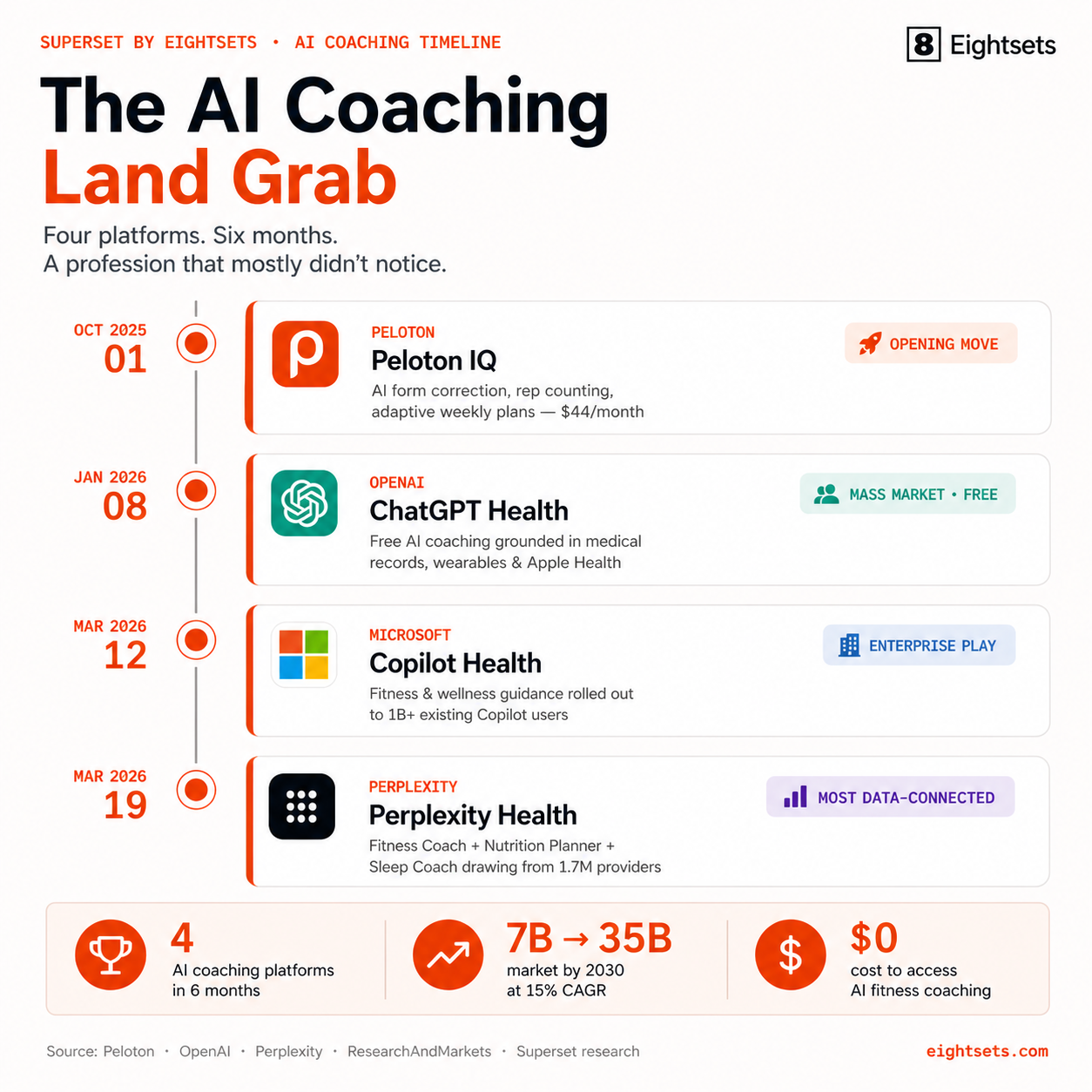
In the past six months alone, four of the most powerful technology companies in the world have launched AI personal trainers and AI fitness coach products. Peloton launched Peloton IQ — real-time form correction and adaptive coaching for forty-four dollars a month. OpenAI launched ChatGPT Health, a free AI fitness coach available across all plan tiers. Microsoft followed with Copilot Health. Perplexity launched a dedicated Fitness Coach, Nutrition Planner, and Sleep Coach, pulling from 1.7 million care providers simultaneously.
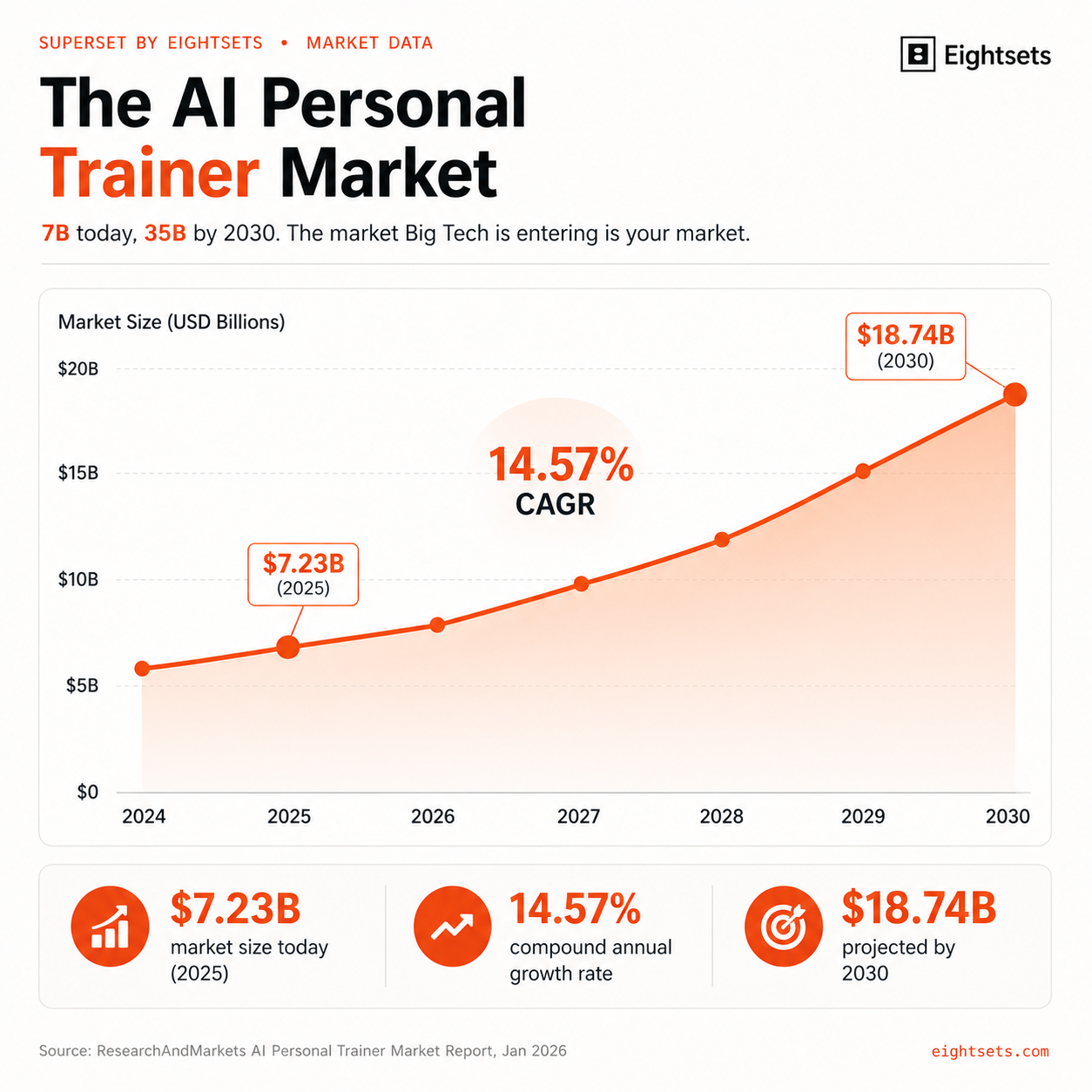
The AI personal trainer market sits at seven billion dollars today. By 2030, it's projected to reach 35 billion — a compound annual growth rate of nearly fifteen percent.
That capital is not being invested in tools to help human coaches work better. It's being invested in products designed to replace the baseline coaching experience that most personal trainers get paid for. And it's moving fast.
There's a number worth sitting with before we go any further: $35 billion.
That's what the global AI personal trainer market is projected to be worth by 2030, up from roughly $7 billion today — a compound annual growth rate of nearly 15%.[1] That is not a niche experiment. That is a capital allocation decision by some of the most sophisticated investors and technology companies in the world. And it is being made in direct response to a market that human coaches have historically owned.
Over the past twelve months, the AI fitness coaching landscape went from a scattered collection of apps and wearable features to a coordinated, well-capitalized assault on the profession. OpenAI, Microsoft, Perplexity, and Peloton all launched or significantly upgraded AI coaching products within the same calendar year. The fitness industry press covered each as an individual product story. What nobody stepped back to see is what these launches look like together: a systematic effort by trillion-dollar platforms to own a service that coaches have built their livelihoods around.
This article is the one that steps back.
■ How the AI Fitness Coach Market Got Here So Fast"
To understand why 2025–2026 became the inflection point, you have to understand what was already happening before the headline launches.
Hundreds of millions of people were already using ChatGPT for health and wellness questions every single week, asking for workout plans, macro targets, recovery advice, and injury modifications. OpenAI knew this. ChatGPT Health didn't create a new behavior. It formalized an existing one and built product infrastructure around it. These platforms aren't trying to convince people to use AI for fitness coaching. They're wrapping a business model around something that's already happening at a massive scale.
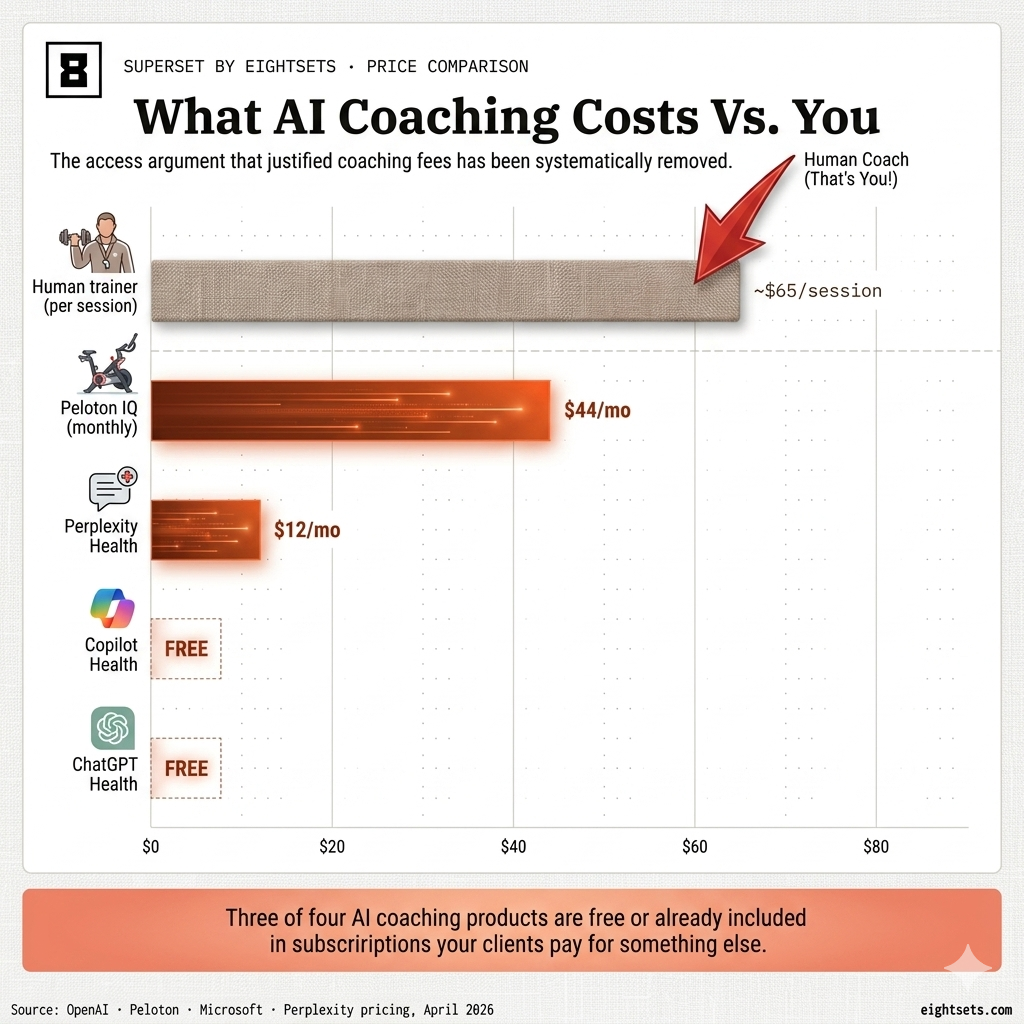
On the hardware side, Peloton's October 2025 relaunch set the tone. CEO Peter Stern framed it explicitly as a new era — not an upgrade. Peloton IQ provides real-time form correction using a built-in computer vision camera, rep counting, weight recommendations, and adaptive weekly plans, all via software update across the entire product line. Price: $44 per month for what a $60–150 per hour human trainer used to be paid to deliver.[2]
Then came the platform companies. And when they arrived, they arrived in a sprint.
■ What AI Personal Trainer Products Actually Do in 2026
The generic framing of "AI fitness coaching" undersells the sophistication of what's now available for free or near-free. Here's what each platform actually delivers to a potential coaching client today.
This is not four separate products. It's a converging architecture — personal health data from wearables, labs, and medical records feeding into personalized coaching recommendations — deployed across four different distribution channels simultaneously. The differentiation between them is the channel. The capability is essentially the same.
A potential personal training client in 2026 can get a workout plan grounded in their Apple Watch data, their recent bloodwork, their injury history from their medical records, and real-time form correction on their Peloton — all before they consider hiring a human trainer. The access argument that has historically justified coaching fees has been systematically dismantled.
"These platforms aren't creating a new behavior. They're wrapping a product around what hundreds of millions of people already do — for free."
■ Peloton IQ: When Your Own Industry Builds the AI Coach
Big Tech launches are easy to frame as external threats. What's harder to sit with — and more important for coaches to understand — is that the fitness industry's own major players are running the same play from the inside.
■ The Peloton playbook — and what it signals
Peloton's October 2025 relaunch explicitly positioned Peloton IQ as "AI personal coaching" — using the language of the profession while engineering a product designed to replace the baseline services coaches have historically been paid for: workout programming, form guidance, and progress tracking.
At the same time, Peloton launched a "Peloton Personal Trainer" beta powered by Trainwell — human coaching as a premium add-on at $99.99 per month above the All-Access Membership. The message: AI coaching is the standard product. Human coaching is the premium upsell. That inversion of the traditional value hierarchy is the signal coaches should pay closest attention to.
Peloton's Chief Product Officer stated it directly: "While others can offer generic AI workouts or insights derived from incomplete data sources, Peloton IQ delivers a more advanced take on AI personal coaching." The word "personal" is doing a lot of work in that sentence — and it belongs to a profession that never ceded it.
The company also launched a Pro Series targeting commercial gyms, hotels, and corporate wellness centers — bringing AI coaching directly into the facilities where human coaches currently work. The equipment competition and the coaching competition are now the same product.
■ Will AI Replace Personal Trainers? What the Research Says
ISSA's 2025 Human Advantage survey of certified fitness professionals found that about 52% already use AI tools daily or several times a week. More than 70% report AI has improved their efficiency or productivity, with roughly one-third describing the impact as significant. ISSA's summary: "AI will not replace trainers. Trainers who learn to use AI well will replace those who do not."[3]
But sitting alongside that optimism is a harder set of numbers. The World Economic Forum's Future of Jobs Report 2025 puts the displacement risk for personal trainers who don't develop AI skills at 40%.[4] The global AI personal trainer market is forecast to nearly double from $16.9 billion in 2025 to over $35 billion by 2030. That capital is not being invested in tools to make human coaches more efficient. It's being invested in products designed to replace the baseline coaching experience that forms the revenue foundation for most mid-market trainers.
The Bureau of Labor Statistics projects 12% employment growth for fitness trainers through 2034 — faster than average, with around 74,200 job openings projected annually.[5] Those projections are likely accurate for job count. But they say nothing about compensation. A growing market with a commoditized baseline is a market where more coaches compete for a smaller share of the premium, while AI platforms capture the volume. More jobs do not mean better pay.
■ Which Fitness Coaches Are Most at Risk from AI Competition
AI coaching's competitive pressure is not uniform across the profession. Here's an honest map of where it lands hardest — and where coaches have real structural protection.
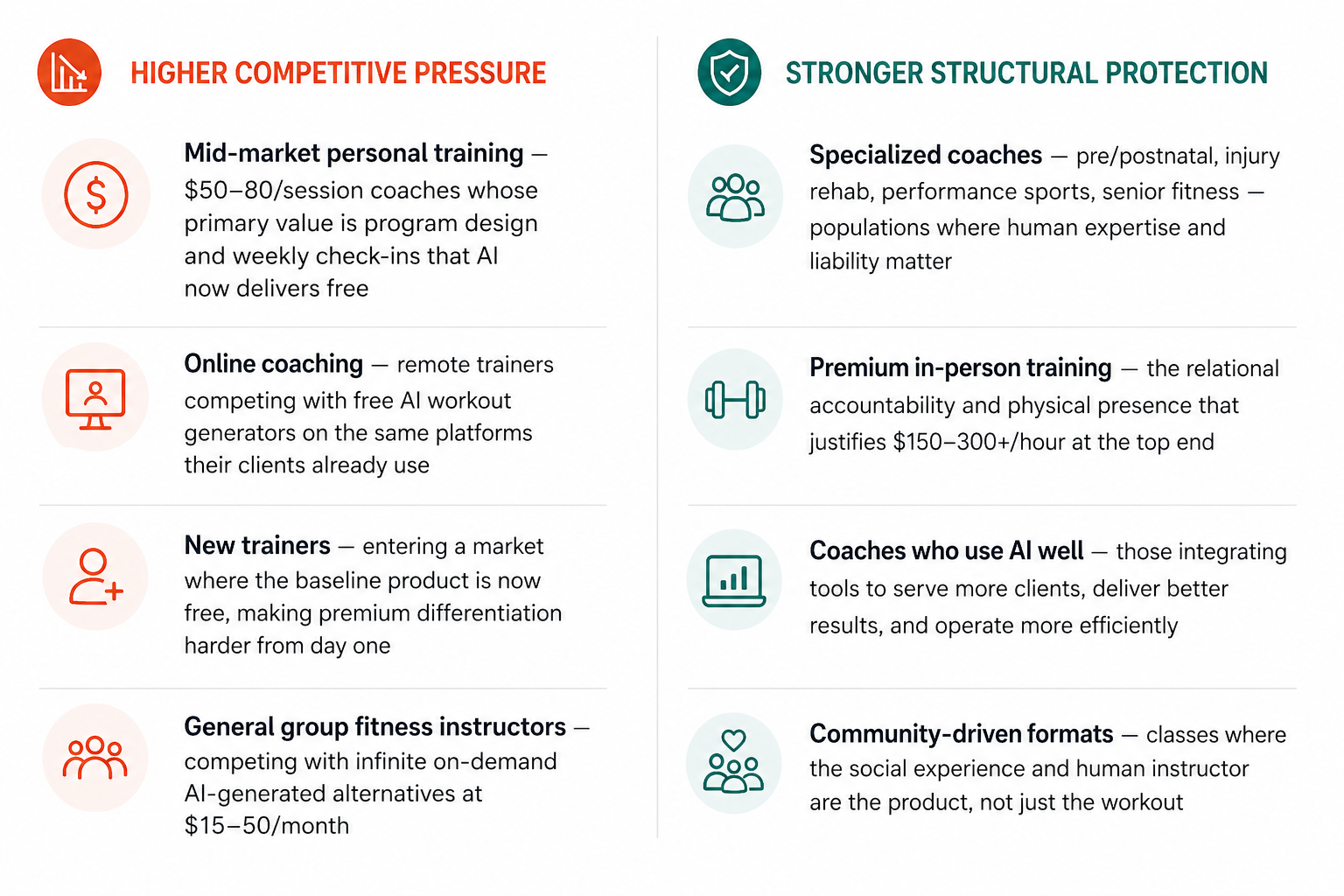
The pattern is consistent across every comparable industry disruption: AI compresses the middle. The highest-value specialists and the AI-augmented generalists thrive. The undifferentiated mid-market gets squeezed. Personal training's mid-market is exactly where the majority of coaches currently operate and where most of the industry's job growth has historically occurred.
■ AI Won't Replace Trainers — Reading the Fine Print
Every launch came packaged with careful language. ChatGPT Health was "designed to support, not replace, professional care," developed with input from over 260 physicians. Perplexity convened a Health Advisory Board. The messaging is consistent: informational tools, not substitutes for professional guidance.
There are two ways to read those disclaimers. The charitable reading: the platforms are genuinely drawing a line between AI health information and professional coaching — they recognize the limits. The less charitable reading: the disclaimers are legal scaffolding. They protect the platforms from liability while the products do exactly what the marketing promises, deliver personalized, data-grounded coaching to anyone with a smartphone subscription.
The honest answer is probably both. The platforms genuinely believe their products complement rather than replace professional coaching for now. But the capabilities are improving at 15% and compounding annually, the price is moving toward zero, and the liability framing will be rewritten as the products get better. The coaches who wait for the disclaimers to change before paying attention will have already lost three to five years of positioning time.
■ AI Is Pressuring Personal Trainer Pay. Nobody Has the Data to Prove It Yet
If AI platforms are compressing the value of baseline coaching — program design, progress tracking, nutrition guidance, workout generation — that compression will show up first in what coaches can charge. A trainer who built their rate card primarily around programming knowledge faces a different client conversation in 2026 than in 2022. The client now has free alternatives grounded in more data than most coaches have access to.
But there's no benchmark to measure against. No public data on what personal trainers charged per session in 2022, 2023, or 2024. No index of group fitness instructor pay by format or market. No way to know whether AI market pressure is already showing up in compensation trends. The number could already be moving. Nobody would know.
This is why the Eightsets benchmark needs to exist before the pressure becomes undeniable — not after coaches are feeling it in their income without understanding why. The data built now tells the story of this transition from the beginning. Data built in two years only tells us how far things have moved without anyone watching.
■ The benchmark only exists if you're in it
The coaches most likely to thrive through the AI transition are the ones who understand their market position clearly. You can't do that without data. Submit your compensation anonymously at Eightsets. It takes two minutes, and your data stays private. Every submission makes the benchmark more useful for every coach in the industry.
■ AI and Fitness Coach Income: Three Things to Watch in 2026
Whether Peloton's human coaching tier holds. The $99.99/month Peloton Personal Trainer beta is the most interesting live test of whether clients will pay a meaningful premium for human coaching when AI coaching is already good. If it converts at scale, it validates the premium. If it underperforms, it tells us something uncomfortable about where the client perceived value is moving.
How certification bodies respond. ISSA, NASM, ACE, and NSCA are the gatekeepers of coaching credentials. If AI platforms increasingly handle what certifications traditionally qualified coaches to do, those bodies face a value proposition problem. Watch for curriculum shifts that lean into specialization, behavior change, and the human skills AI can't replicate.
Rate data from Eightsets. The most direct signal will come from real compensation submissions. If per-session rates start declining in mid-market categories while remaining stable at the premium end, the compression pattern is confirmed. Superset will be the publication reporting it — because nobody else is positioned to.
Big Tech called coaching a feature. The profession's job now is to prove with data, with specialization, with the things algorithms cannot replicate, that it's something more.
Sources & references
- [1]AI Personal Trainer Market Outlook 2025–2032 — ResearchAndMarkets / GlobeNewswire, Jan 2026
- [2]Peloton Enters New Era with AI-Powered Peloton IQ — Peloton Interactive, Oct 2025
- [3]The Human Advantage: How AI Is Reshaping Personal Training — ISSA, Dec 2025
- [4]Personal Fitness Trainer AI Career Assessment — What About AI / WEF, Feb 2026
- [5]Are Personal Trainers in Demand? 2026 Outlook — FitBudd / BLS data
- [6]Perplexity Health Launches, Bringing AI Deeper Into Wellness — Athletech News, Apr 2026
- [7]ChatGPT Health Debuts With Peloton, Weight Watchers as Early Partners — Athletech News, Jan 2026
- [8]Peloton Signals New Era With AI Fitness Coaching, Equipment Overhaul — Athletech News, Oct 2025
- [9]New "Peloton Personal Trainer" Beta Feature Launched — Peloton Buddy, Feb 2026
- [10]Perplexity Has Launched Perplexity Health — TNW, Mar 2026
- [11]The AI Personal Trainer Is Coming — Will Ventures Substack, Jan 2026
- [12]Personal Fitness Trainer Market Size & Trends 2026–2036 — Future Market Insights, Feb 2026
Member discussion