The Certification Business: Who's Really Getting Paid?

Personal trainer certification can cost up to $2,000. Then, recertification every two years. Then specializations. Then CEUs. The fitness credential industry has built a recurring revenue machine on top of a workforce that earns below the national median. And now, with AI disrupting everything they sell, the same organizations are selling the solution too.
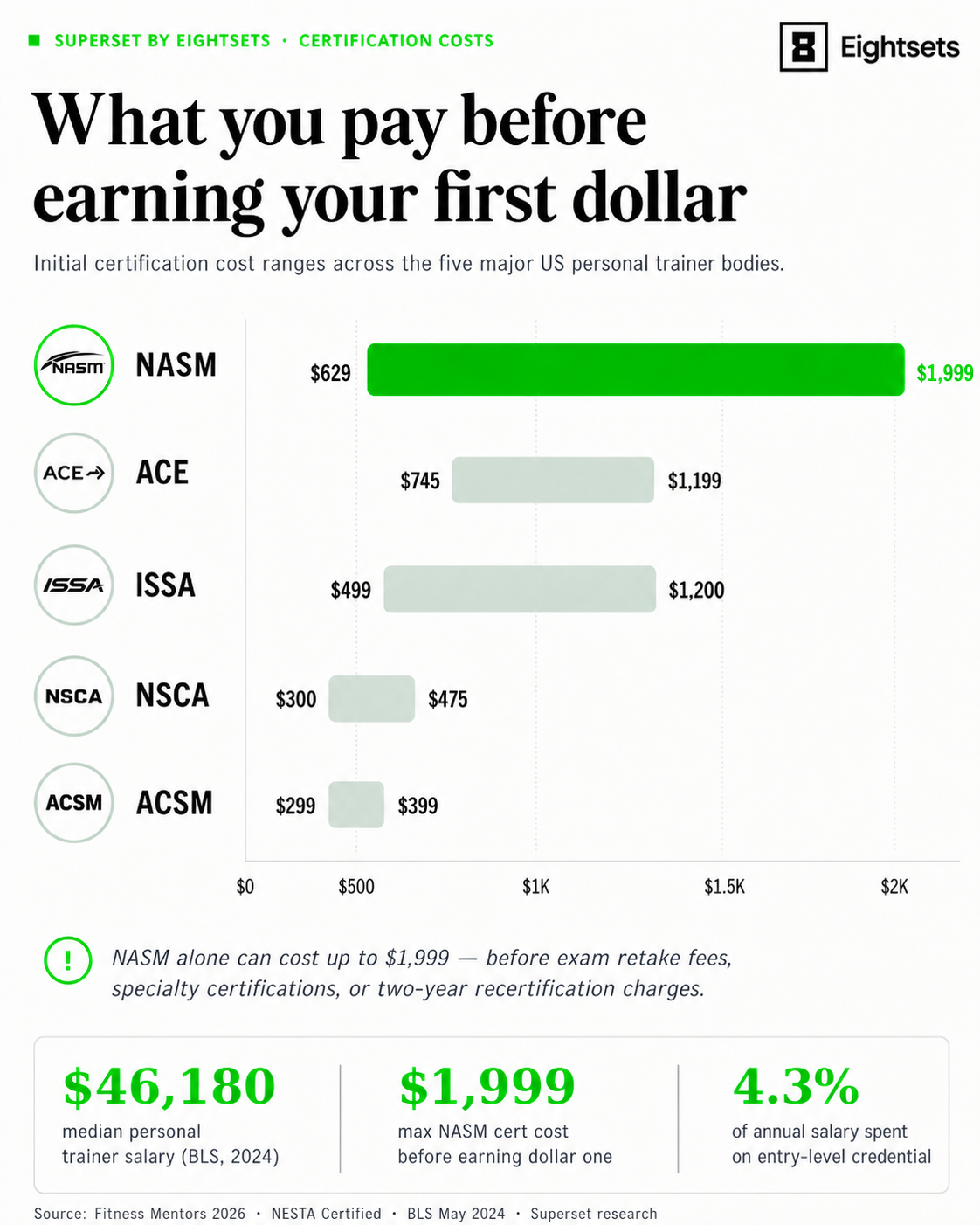
Before a personal trainer earns their first dollar, they spend hundreds or thousands getting certified. That's the entry toll the fitness profession has always charged. Pay to get in, prove you know what you're doing, and then go build a career.
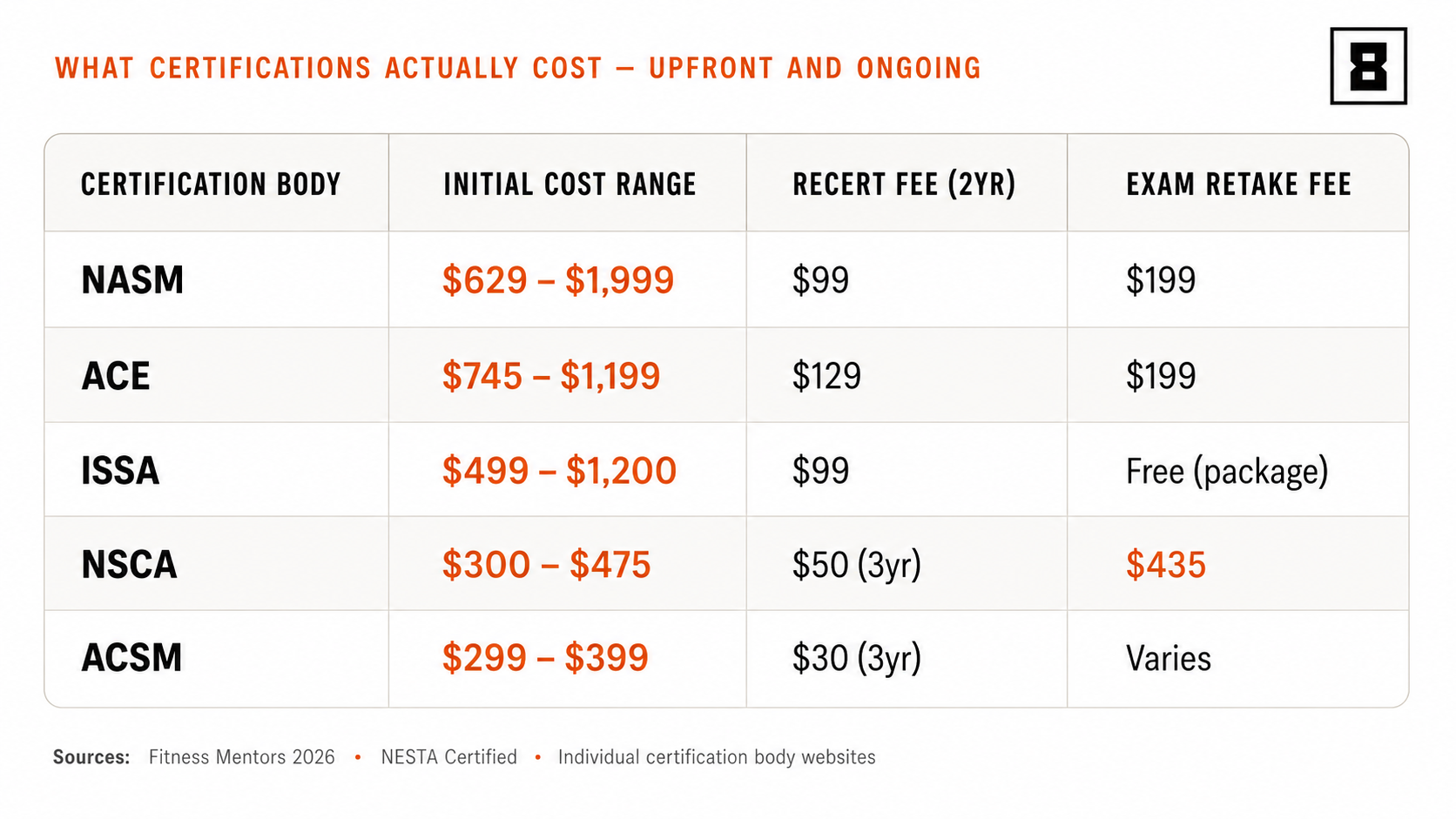
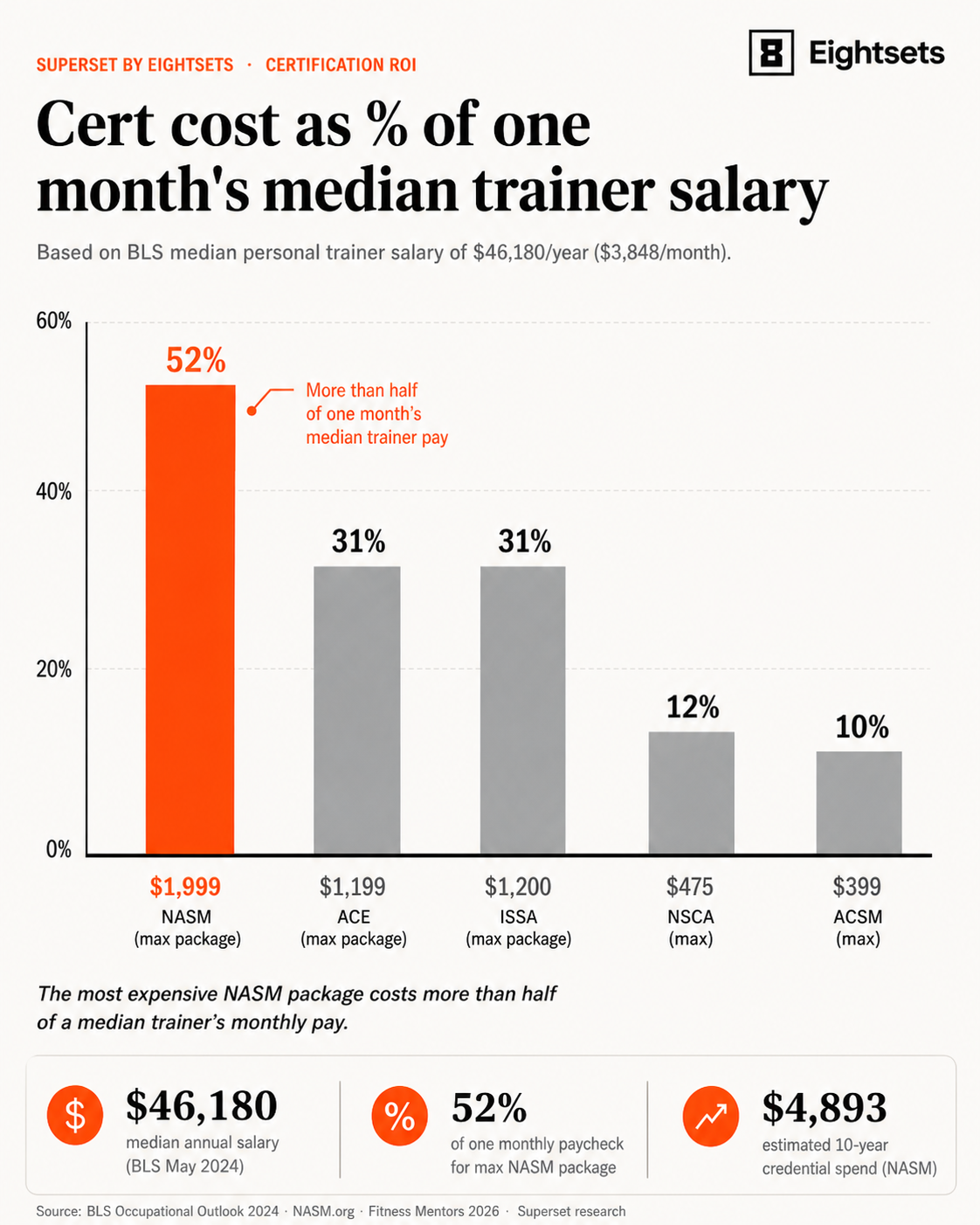
The personal trainer certification cost alone ranges from $499 on the low end to nearly $2,000 for a premium NASM package. That's before the exam retake fee if you fail. Before the recertification charge, every two years. Before the continuing education credits are required to stay certified. Before the specialty credentials, the bodies keep adding to their catalogs, each one promising higher earning potential and each one costing more money you haven't made yet.
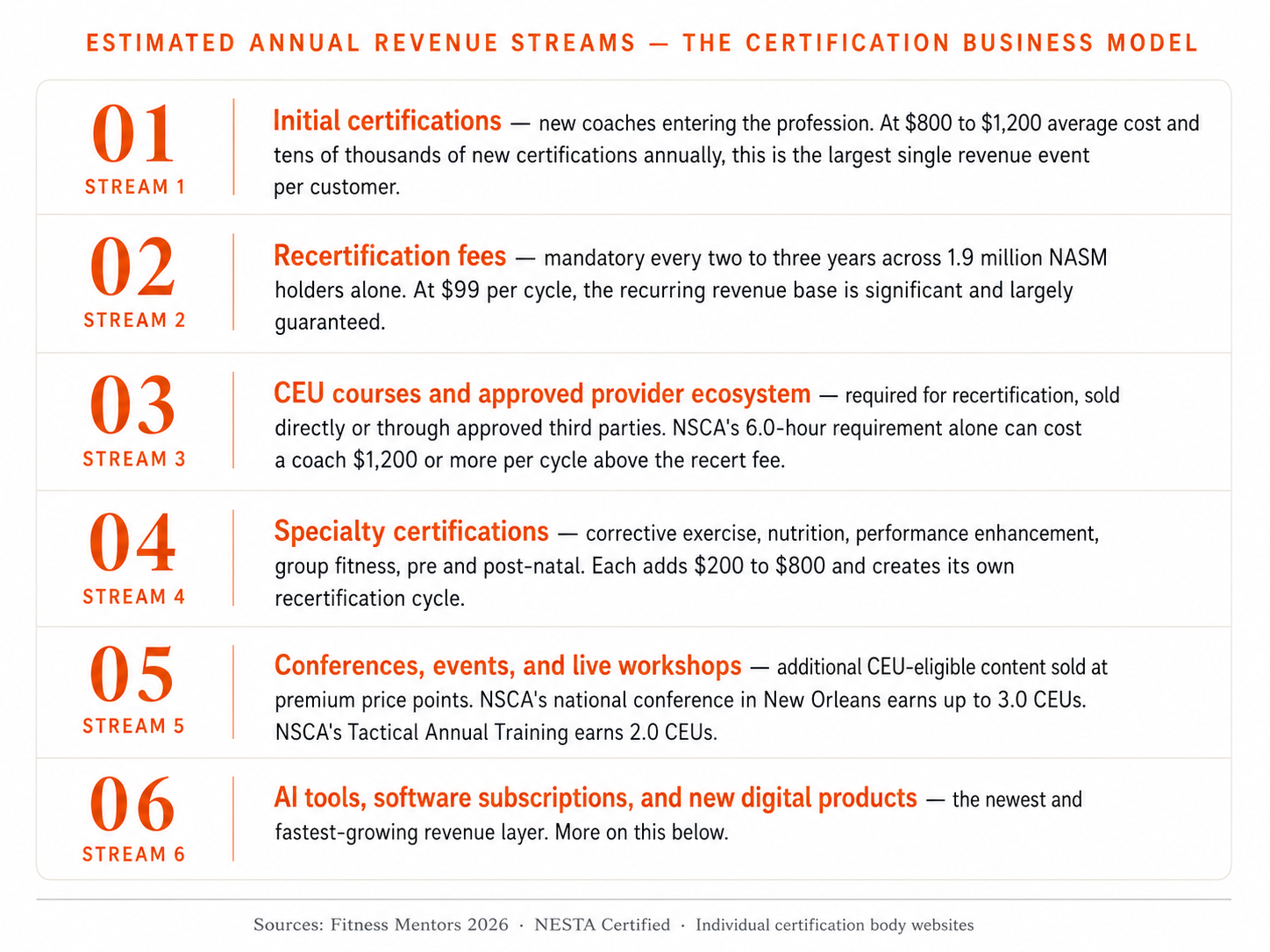
The fitness certification industry has built something that looks, from the outside, like a professional standards organization. From the inside, it runs a lot more like a subscription business. The credentials are mandatory for most gym employment. The recertification cycle is mandatory to keep them. The CEU requirements — which the certification bodies approve and often sell directly — are mandatory to recertify. And now, as AI disrupts the baseline value of the credentials themselves, the same organizations are launching AI tools, AI specializations, and AI-powered learning platforms to capture the disruption revenue too.
We are not arguing that certifications have no value. They do. What we're examining is the financial structure built around them, what it costs coaches over the course of a career, and whether the credential investment actually shows up in pay. That last question is the one nobody in this industry has clean data to answer until now.
■ How the Personal Trainer Certification Business Model Actually Works
Start with the numbers that matter most. NASM has certified more than 1.9 million professionals across over 100 countries since 1987.[1] That is not a small professional association. That is a large education business, built on a mandatory credential that most gyms in the country require as a condition of employment.
In 2025 alone, 19,338 candidates passed NASM's accredited exam out of 22,843 attempts — an 85 percent pass rate.[2] At an average certification cost somewhere between $800 and $1,200 before you factor in study materials, that is roughly $15 to $23 million in new certification revenue from the accredited exam pathway alone in a single year. Then every two years, a meaningful portion of those 1.9 million certified professionals pays $99 to stay current.
The recurring math is where this gets significant. Even at a conservative estimate — say 500,000 active NASM holders recertifying in any given two-year cycle at $99 each — that is $49.5 million in recertification revenue before a single specialty certification or CEU course is sold. The certification bodies do not publish their financials publicly, so Superset cannot give you the exact number. But the structure of the model is not hidden. It is simply not discussed.
"Certification bodies have built a subscription model on top of a mandatory credential. Coaches pay to get in, then pay to stay in, every two years, forever."
■ The CEU Economy — A Market The Bodies Largely Control
Continuing education units are where the model gets genuinely layered. To recertify, coaches must earn a set number of CEUs from approved providers. NASM requires 20 hours of CEUs every two years. ACE requires 20 hours at $129. NSCA sits at the far end of the spectrum, requiring 60 hours of CEUs every three years — a volume that, at the industry average of roughly $20 per contact hour in CEU courses, adds up to roughly $1,200 in education spending above the recertification fee itself.[3]
The approved provider ecosystem is the part of this business most coaches never think about. Certification bodies control which courses count toward CEU requirements. That approval process — officially framed as quality control — also functions as a gatekeeping mechanism. Third-party education providers pay to become approved. Certification bodies sometimes sell CEU-eligible courses directly. The coach in the middle pays for courses that satisfy a requirement set by the same organization.
This is not a conspiracy. It is a business model. And it works because the underlying credential is genuinely valuable in the labor market — gyms require it, clients expect it, and insurance often demands it. The model's durability depends entirely on that legitimacy remaining intact. Which brings us to the question AI has just made urgent.
■ Does Personal Trainer Certification Cost Actually Pay Off?
This is the question that connects all of it to Eightsets. Coaches are told, consistently, that investing in certifications and specializations moves their rate card. The data is more complicated than that framing suggests.
ACE-certified trainers earn between $40,000 and $60,000 annually. NASM-certified trainers reportedly earn up to $70,000. ISSA-certified trainers land in a range similar to ACE, between $40,000 and $65,000.[4] The Bureau of Labor Statistics puts the median annual income for personal trainers at $46,180 as of May 2024, with top earners reaching $83,770.[5]
The certification to pay correlation exists, but it is not clean, and the industry press rarely interrogates it. The coaches earning $70,000 with NASM certifications are not earning that because of the NASM credential alone. They are earning it because of location, specialization, client roster quality, years of experience, and the ability to retain and upsell clients — factors the certification itself does not guarantee or even directly train for.
The specific question nobody can currently answer is this: does adding a specialty certification in, say, corrective exercise or nutrition actually increase what a coach can charge per session? And by how much? The certification bodies say yes. They have a financial interest in that answer being yes. The independent data to verify it in either direction does not exist publicly. That is the information gap Eightsets is built to close, and it is a gap the certification industry benefits from remaining open.
■ The NCCA accreditation structure — and why it matters
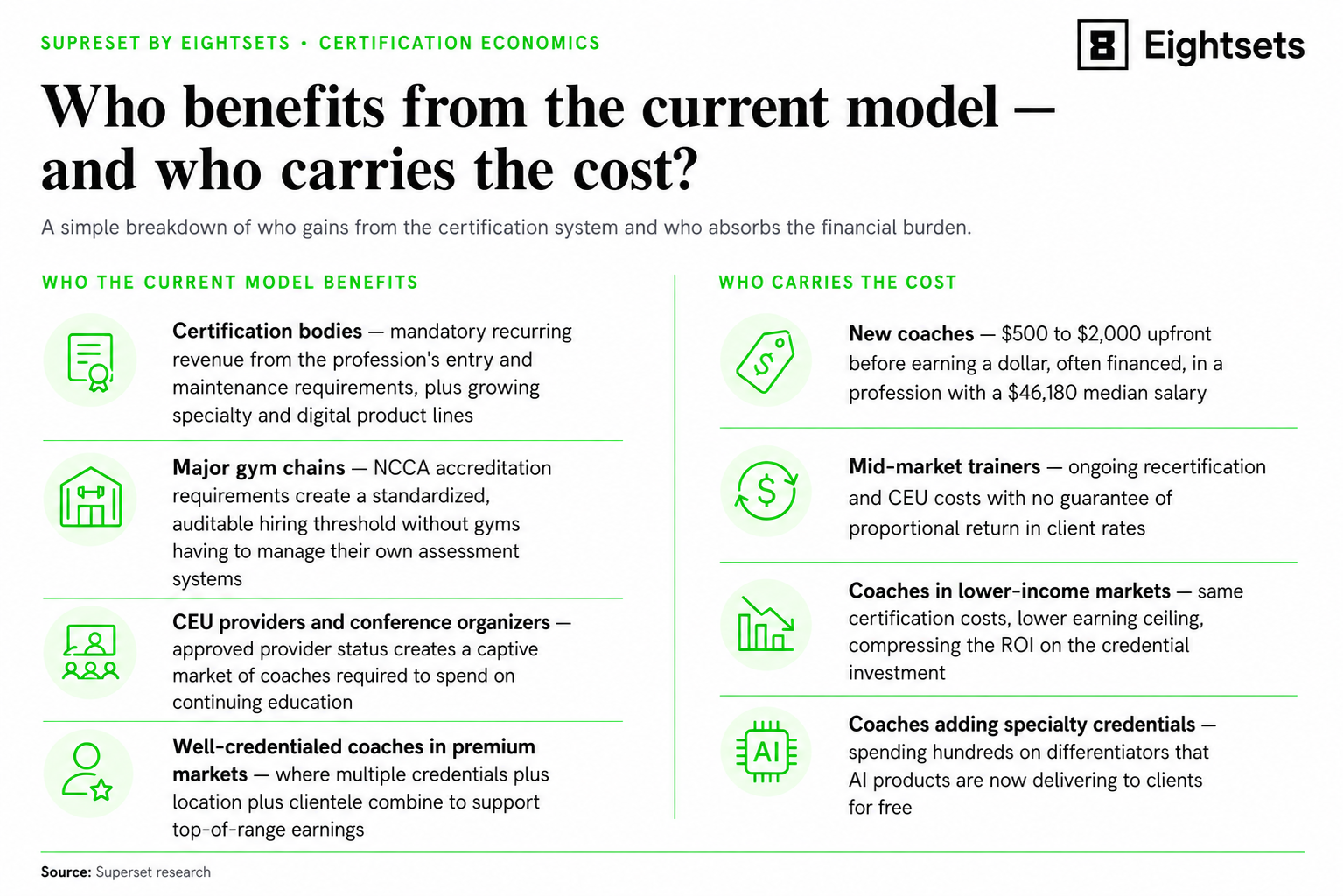
The National Commission for Certifying Agencies is the body that accredits fitness certifications and gives them their employment currency. Nearly 99 percent of major gyms require or expect NCCA-accredited certifications as a condition of employment. NASM, ACE, and NSCA all hold this accreditation. ISSA's situation is more complicated — ISSA itself is not subject to NCCA oversight. Its accredited pathway runs through the NCCPT, an affiliate company, and in 2025 only 734 candidates passed the NCCPT accredited exam compared to NASM's 19,338.
The practical effect of NCCA accreditation is that it functions as a gatekeeper for gym employment. Coaches who hold non-accredited certifications — or certifications from smaller providers — often find themselves unable to work at major facility chains regardless of their actual knowledge or coaching ability. This structure concentrates market power in the handful of bodies that hold NCCA accreditation, and it ensures their credential remains mandatory as long as the gym chains maintain their hiring requirements. It is a self-reinforcing system that benefits the established players and the gyms simultaneously — the coaches are the ones paying to participate in it.
■ The AI Double Play — Selling the Problem and the Solution
Here is where the story gets genuinely uncomfortable for the certification bodies, and genuinely important for coaches to understand.
Superset has been covering the AI fitness coaching land grab — Peloton, OpenAI, Microsoft, Perplexity, and now Spotify all entering the space within months of each other. The thesis of that coverage is that AI is compressing the market value of baseline coaching services: workout programming, form guidance, progress tracking, nutrition planning. The things most mid-market personal trainers get paid for.
Those are also, almost exactly, the competencies that fitness certifications train for and test on.
If an AI platform can generate a personalized training plan grounded in a client's Apple Watch data, medical records, and injury history for free, the credential that qualifies a coach to do the same thing faces a value proposition problem. Not immediately. Not completely. But directionally, and with enough capital behind the AI side to keep improving at 15 percent compounding annually, the pressure is real and it is building.
What makes this moment particularly interesting is how the certification bodies are responding. NASM has embedded "Claire AI" into its learning ecosystem — an AI-powered support system for candidates studying for certification.[2] The same AI wave threatening the downstream value of the credential is now powering the product they sell to create it. That is not necessarily cynical — AI learning tools can genuinely improve certification quality. But it is worth naming clearly.
NASM's more significant move is the launch of NASM One — a subscription membership that includes no recertification or renewal fees, 50 percent savings on certifications and specializations, and access to EDGE Trainer Pro, their business management software.[6] This is a direct pivot toward a recurring subscription model — moving from transaction-based revenue toward the kind of monthly or annual subscription that provides more predictable cash flow and deeper customer lock-in. The timing is not coincidental. As AI challenges the necessity of recertification as currently structured, NASM is restructuring its revenue model before that pressure fully materializes.
"The AI wave threatening the value of fitness credentials is now powering the tools certification bodies use to sell more of them. That is a loop worth paying attention to."
■ The Specialization Treadmill
Specializations deserve their own section because they represent the most direct intersection of certification industry revenue and the AI disruption story.
Every major certification body has a growing catalog of specialty credentials: corrective exercise, performance enhancement, nutrition coaching, behavior change, group fitness, pre and postnatal training, senior fitness, youth fitness. Each costs between $200 and $800. Each requires its own ongoing CEU maintenance. Each is sold on the promise of higher earning potential and a differentiated client offer.
Some of those promises are real. A pre and postnatal specialization genuinely opens a client population that requires specific knowledge and carries real liability if done incorrectly. A corrective exercise credential matters when working with injured populations. These are defensible credentials with clear practical application.
The nutrition specialization is where the argument gets more complicated. Nutrition coaching certification from NASM, ACE, or ISSA trains coaches to provide general dietary guidance within a defined scope of practice. Perplexity Health launched a dedicated Nutrition Planner feature drawing from a client's lab results, wearable data, and records from 1.7 million care providers simultaneously. ChatGPT Health provides nutrition guidance grounded in a client's medical history, free, on every subscription tier.
The coaches who spent $500 on a nutrition specialization to differentiate their offer are now competing with a free AI product that has access to more of their client's health data than they do. The certification body that sold that specialization is still collecting the fee and the CEU revenue. The coach is the one who has to figure out what to do next.
■ What the Pay Gap Data Would Show — If It Existed
Here is the core problem that sits underneath all of this. The fitness certification industry's claims about earning potential are largely based on broad salary surveys that do not control for the variables that actually drive coach income: location, client demographics, years of experience, facility type, and whether the coach operates independently or as an employee.
The certification bodies cite salary ranges that make their credentials look like a worthy investment. Those ranges are real in aggregate. What they do not tell you is whether a specific certification, at a specific price point, in a specific market, actually moves a coach's hourly rate. That question requires granular compensation data by credential, by market, and by facility type. Data that does not currently exist publicly.
A coach in Brooklyn with an NASM CPT and a corrective exercise specialization cannot currently look at any public data source and know whether their $1,800 in total credential spending has returned value proportional to the investment. They cannot benchmark their current rate against coaches with the same credentials in the same market. They cannot know whether adding a nutrition specialization would justify the $500 cost in actual session rate increases.
That is the information gap. And it is not an accident that it persists. An industry whose revenue model depends on coaches continuing to invest in credentials has limited incentive to produce research showing exactly what those credentials return in practice.
■ What Needs to Change — and What Coaches Can Do Now
The certification industry is not going away, and we are not arguing that it should. Professional standards matter. Credentialed coaches are meaningfully better prepared than uncredentialed ones. The NCCA accreditation system, whatever its flaws, provides employers with a usable hiring signal in a fragmented labor market.
What needs to change is the transparency layer around the credential investment. Coaches deserve to know what their certification dollars are actually returning in the labor market. That means credential-level compensation data — not broad salary surveys, but granular data showing what coaches with specific certifications, in specific markets, working in specific facility types, are actually charging and earning.
It also means the certification bodies are facing pressure to demonstrate that their credentials remain valuable as AI encroaches on the knowledge base that those credentials have historically certified. The answer is almost certainly yes — human coaching has defensible value that AI cannot currently replicate, and the right credentials signal that to the right clients and employers. But "almost certainly" is not a business plan. And the coaches paying for those credentials deserve better than a credential body's word on it.
The industry also needs to reckon honestly with what AI specializations are worth versus what they cost. A credential that qualifies a coach to do something an AI product now does for free is not worthless — it signals professional commitment, liability coverage, and depth of knowledge. But it may not justify its current price point as a standalone differentiator. The certification bodies that figure this out first and restructure their specialty offerings accordingly will be better positioned than the ones still selling nutrition coaching credentials like it's 2019.
The certification industry's claims about earning potential depend on there being no public data to check them against.
Eightsets is building that data — granular compensation information by credential, market, and facility type that lets coaches actually evaluate the return on their certification investment.
Submit your compensation anonymously at eightsets.com. Two minutes.
Your data stays private. And every submission makes the benchmark more useful for every coach in the industry.
■ What to Watch
NASM One's adoption rate: If coaches embrace the subscription model at scale, it signals they value the ongoing access to tools and community over the transaction model. If it underperforms, it tells us coaches are looking for alternatives to the traditional certification lock-in. Either answer is instructive for where the credential industry is heading.
Whether certification bodies launch AI-specific credentials: The pattern in every industry facing AI disruption is the same: incumbent players launch credentials certifying expertise in the disrupting technology. Expect NASM, ACE, and ISSA to launch AI fitness coaching specializations within the next 12 to 18 months. Watch the price point and whether they position it as a defensive add-on or a genuine new competency.
Eightsets data by credential: As submissions grow, Superset will publish the first public analysis of compensation by certification type, market, and facility. If NASM-certified coaches in NYC boutique studios are genuinely earning a premium over ACE-certified coaches doing similar work, the data will show it. If the premium is smaller than the certification price difference, that will show too. This is the reporting the certification industry has never had to face — and the information coaches have always deserved.
Credentials cost money. The industry that sells them makes a lot of it. Whether the investment returns proportional value to the coaches who make it is a question that has never had a clean public answer. We are going to find one.
Sources & references
- [1]About NASM — National Academy of Sports Medicine (1.9M+ certified professionals)
- [2]NASM vs. ACE vs. ISSA: Which Certification Actually Gets You Hired? — NASM, 2025 (19,338 passers; Claire AI; NCCA accreditation)
- [3]Best Personal Trainer Certification — Top 10 CPTs for 2026 — Fitness Mentors (CEU requirements and costs across all bodies)
- [4]ACE vs. NASM vs. ISSA: Salary and Certification Comparison — NESTA Certified, Mar 2026
- [5]Are Personal Trainers in Demand? 2026 Outlook — FitBudd / BLS data (median salary $46,180)
- [6]NASM One — Subscription Model Launch — NASM.org, 2025
- [7]NASM vs ACE: Comparing 7+ Criteria — Trainer Academy, updated Nov 2024
- [8]The Human Advantage: How AI Is Reshaping Personal Training — ISSA Human Advantage Survey, Dec 2025
- [9]Perplexity Health Launches, Bringing AI Deeper Into Wellness — Athletech News, Apr 2026
- [10]NSCA 2026 Conference and CEU structure — National Strength and Conditioning Association
- [11]NASM CEU Requirements and Approved Provider Structure — Fitness Education Online
- [12]AI Personal Trainer Market Outlook 2025–2032 — ResearchAndMarkets / GlobeNewswire, Jan 2026
Member discussion