The Corporate Fitness Pay Gap: Who's Really Keeping the Money?

Corporate fitness is a $70 billion industry growing toward $100 billion. The coaches delivering that wellness are earning below the national average. In between sits a vendor layer that sets rates, takes margins, and operates almost entirely out of sight. This is how corporate fitness coach pay works, actually.
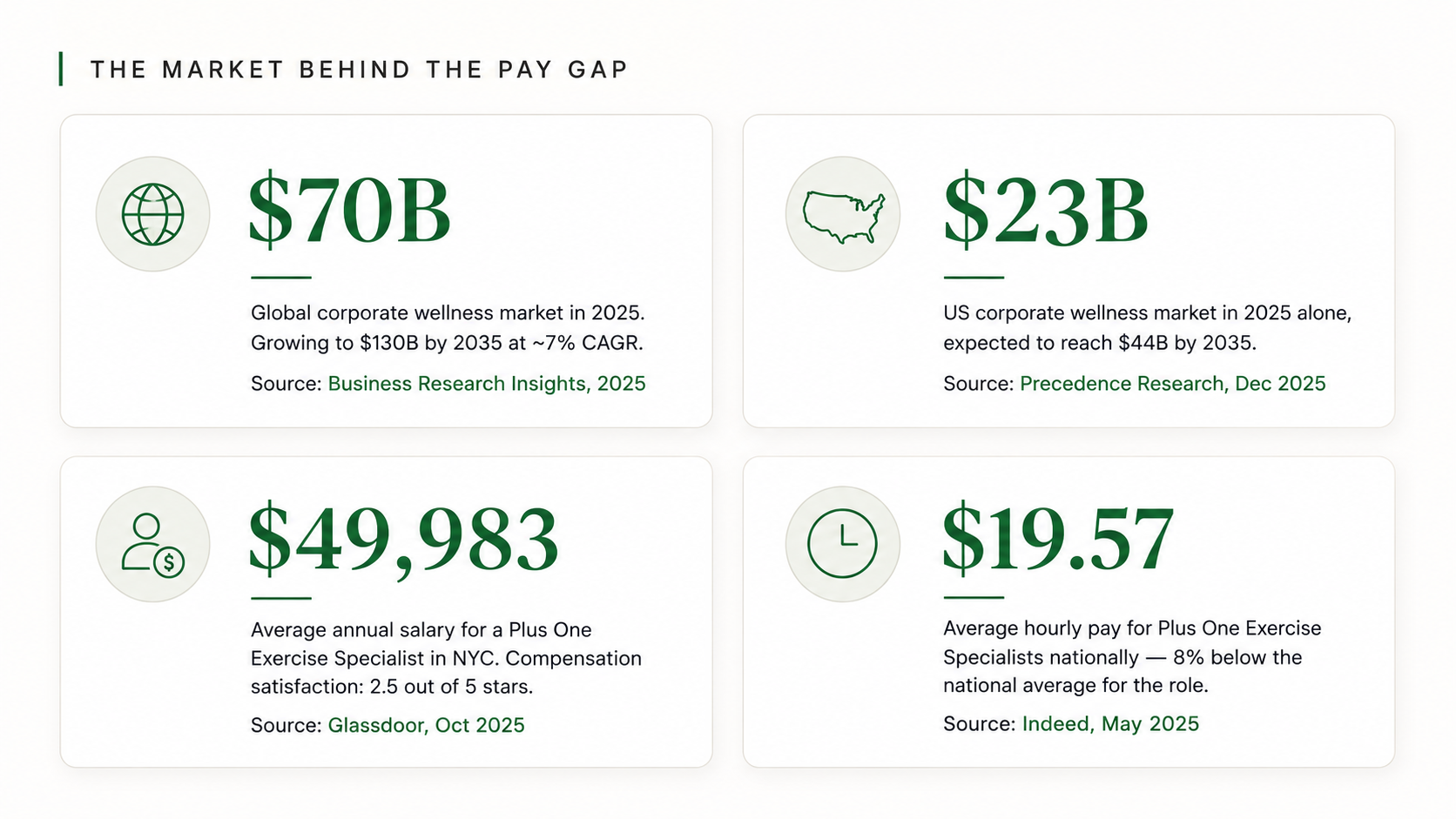
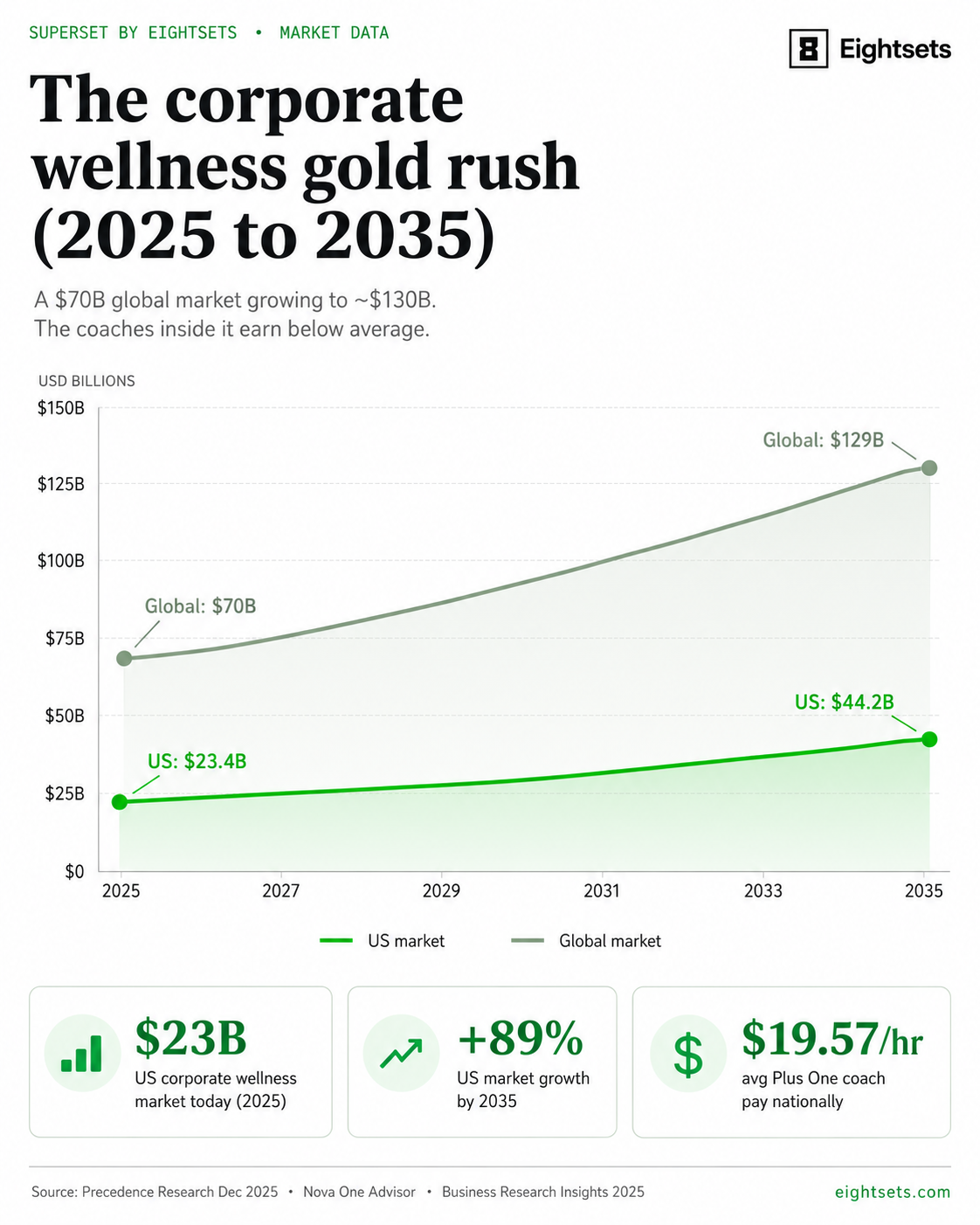
The pitch that corporate fitness vendors make to HR departments is straightforward. Companies that invest in employee wellness see higher productivity, lower absenteeism, and reduced healthcare costs. The data supports it. The global corporate wellness market sits at roughly $70 billion in 2025 and is on track to cross $100 billion by 2035.[1] Large-scale organizations are spending more on employee wellness programs than at any point in history. The corporate fitness coach pay gap, however, tells a different story from the boardroom projections.
The coaches, trainers, and exercise specialists delivering that wellness are earning wages that sit at or below the national average for the profession. In some cases significantly below. And the structural reason for that gap is not widely discussed inside the industry, because the companies benefiting from it have every reason to keep the conversation focused on market size, employee engagement metrics, and the ROI of wellness programs for employers.
Superset is having the other conversation. This piece covers two things: what corporate fitness actually pays across the managed services model, using Plus One as the primary case study given its scale and its direct connection to one of the largest healthcare companies in the world. And what happens to coach pay inside the vendor platform model, where companies like Wellhub and ClassPass Corporate sit between the corporate budget and the studio or coach getting paid.
Both stories connect to the same information gap. Corporate fitness coaches, whether employed by a managed services operator or contracted through a platform, largely have no public benchmark to evaluate whether what they're earning reflects what the market is paying. That is not an accident.
■ Understanding the Corporate Fitness Coach Pay Gap: Two Models, One Problem
Before getting into the specifics, it helps to understand the two distinct structures operating under the "corporate fitness" umbrella. They create different pay dynamics and different problems for coaches, but both point to the same underlying issue.
The first model is managed services. Companies like Plus One, EXOS, and HealthFitness physically staff and operate corporate fitness centers on behalf of employers. Banks, law firms, pharmaceutical companies, and tech campuses across New York and nationally hire these vendors to run their on-site gyms, manage fitness programming, and employ the coaches working those facilities. Coaches in this model are typically W-2 employees with benefits, consistent hours, and a negotiated salary or hourly rate. The stability is real. The compensation, as Superset will show, is not always proportional to the market they serve.
The second model is marketplace platforms. Companies like Wellhub, formerly Gympass, and ClassPass Corporate aggregate fitness studios, instructors, and wellness providers into a corporate benefits package that employers offer employees as a perk. Studios and coaches don't work for these platforms directly. They contract with them. The platform sets the reimbursement structure, takes its margin, and the studio or instructor gets what remains. The coach or studio owner typically has no visibility into what the corporate client is paying the platform per employee.
Both models are growing rapidly. Both are profitable for the vendors at the top of the structure. And in both cases, the coaches at the bottom of the chain are pricing their labor without a benchmark to measure against.
■ Plus One, an Optum Company: The NYC Story
Plus One is the most significant player in the managed corporate fitness space in New York City, and arguably the most important company to understand for any fitness professional considering a corporate wellness career in this market.
Plus One was acquired by Optum, the health services arm of UnitedHealth Group, making it part of one of the largest healthcare companies in the world. The company provides fitness and wellbeing services to clients across a broad range of industries, with services spanning fitness, nutrition, ergonomics, wellness coaching, and health promotion.[2] Its client roster skews toward the exact corporations that dominate the NYC market: financial services, legal, media, and professional services firms with premium on-site facilities.
The profile sounds like a strong employer for fitness professionals. Access to major corporate clients, operational infrastructure, benefits as a UnitedHealth Group subsidiary, and positioning inside the healthcare industry's most powerful ecosystem. The reality of what the role pays tells a more complicated story.
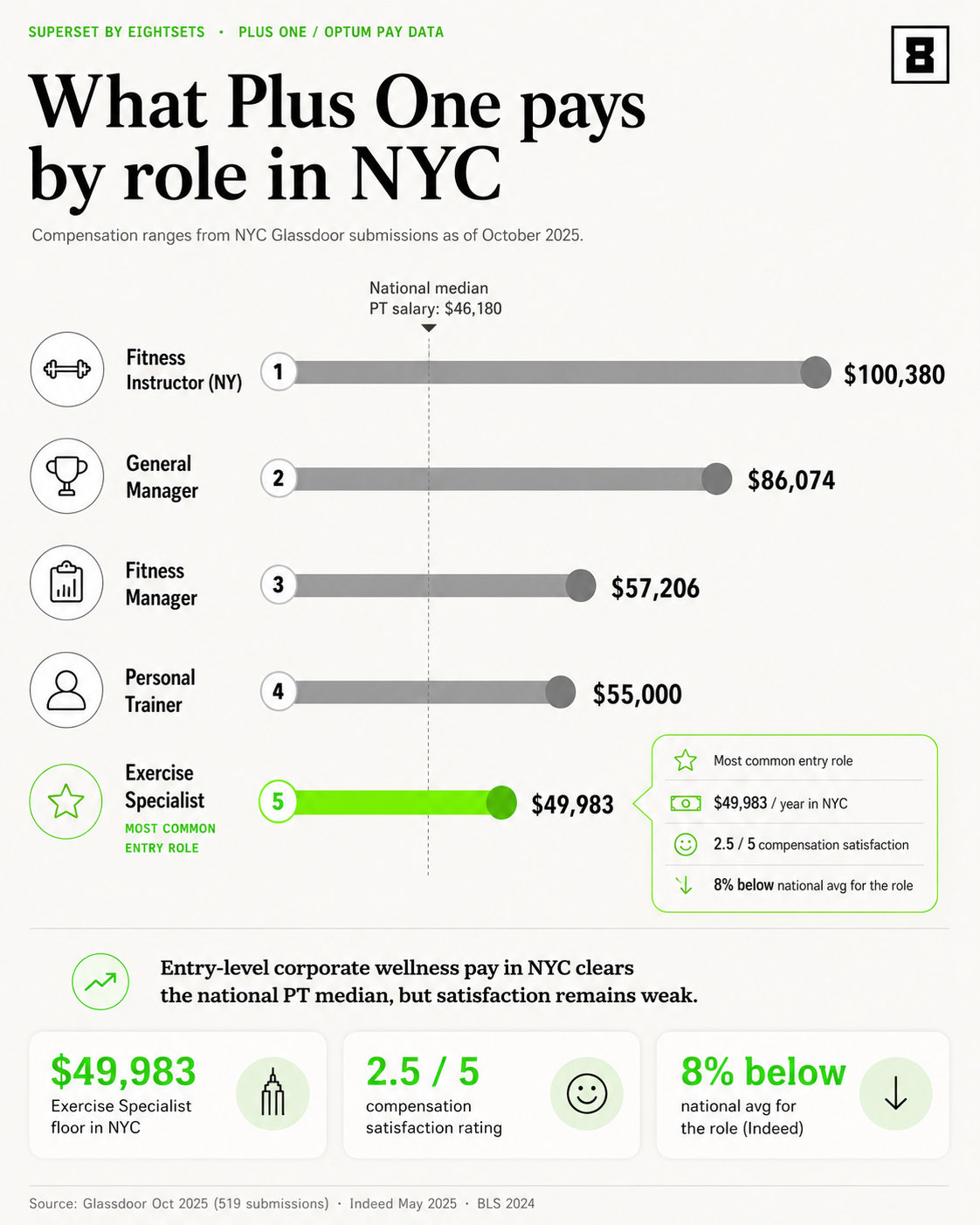
In New York City, Glassdoor puts the average Plus One Exercise Specialist salary at $49,983 per year, based on 519 employee submissions as of October 2025. The role ranges from Exercise Specialist at the $49,983 floor to General Manager at $86,074.[3] Nationally, Indeed reports the average Exercise Specialist hourly pay at $19.57, which is 8 percent below the national average for the role.[4]
The employee reviews put texture on those numbers. One Indeed reviewer described the situation directly: "A good first job out of college but the base pay is too low to live on, requiring many hours of personal training on and off-site." Another noted: "Pay is based on contract size with client, but most aren't making much more than the other. Good for a short term, but not somewhere you can grow real roots with little room for advancement."[5]
That second review contains one of the most revealing phrases in this whole story. "Pay is based on contract size with the client." The coach's compensation is determined not by their skills, certifications, or experience, but by how much Optum negotiated in its service contract with the employer. The coach has no visibility into that contract. They have no leverage in relation to it. They take what the managed services operator offers, which is itself a function of a margin structure the coach never sees.
"Pay is based off contract size with client. Most aren't making much more than the other. Good for a short term, but not somewhere you can grow real roots."
■ The Managed Services Margin Structure
Understanding why corporate fitness coach pay looks the way it does requires understanding how managed services contracts actually work.
When a financial firm in Midtown Manhattan hires Plus One to run its fitness center, it pays a management fee based on the scope of the facility, the staffing requirements, and the services delivered. That management fee covers the vendor's costs, including coach salaries, facility management, programming, and reporting, plus the vendor's margin. The corporate client is not paying for the coach's expertise directly. It is paying for a managed service, and the vendor allocates costs within that structure.
The result is that coach pay inside managed services is not set by the market for fitness professionals. It is set by what the vendor can afford to pay after covering its own margin, which is itself constrained by what the corporate client negotiated. The coach at the bottom of that chain has no information about any of those numbers. They see their offer letter and nothing else.
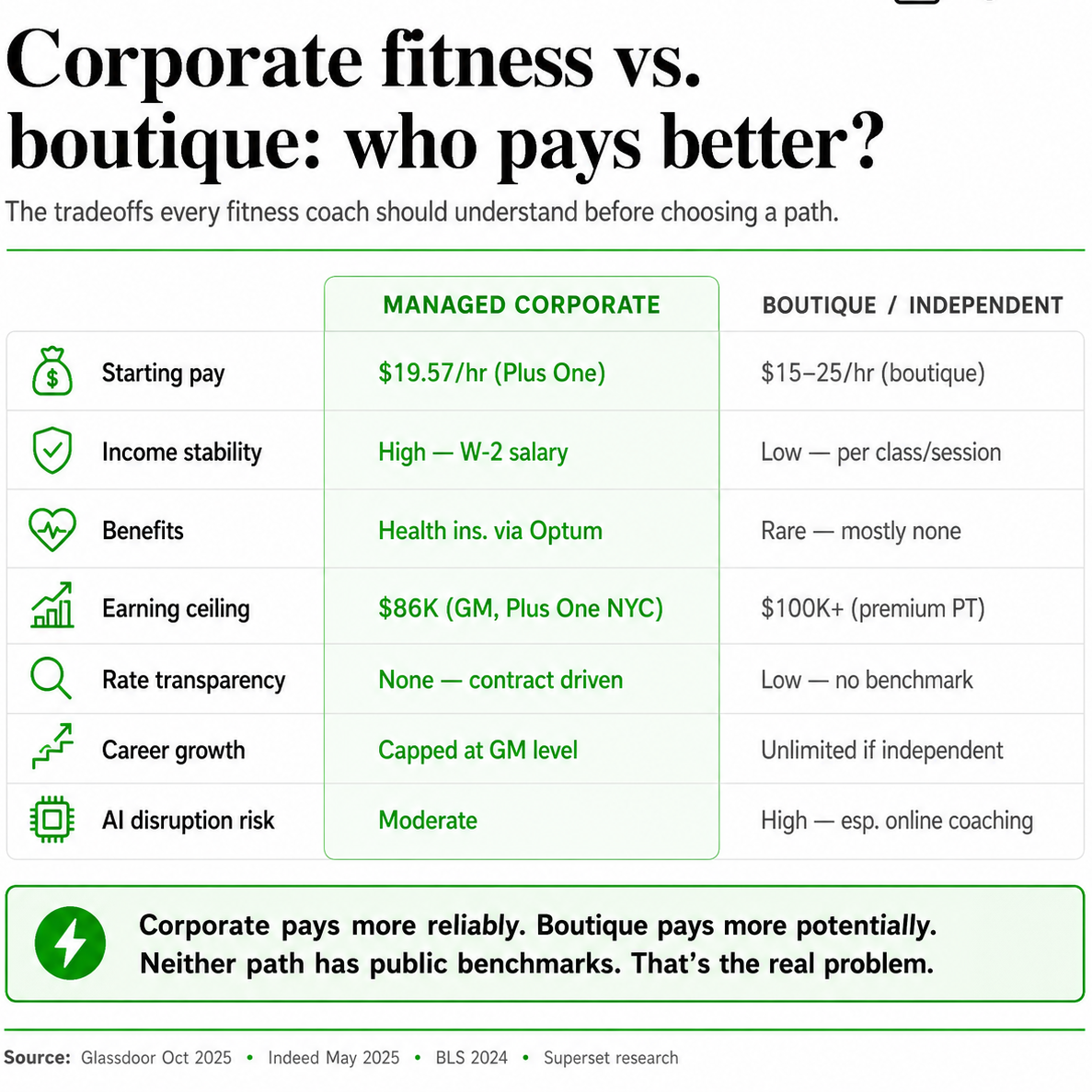
This is materially different from how pay works in boutique fitness, where a per-class rate or session fee has at least some relationship to what the market will bear from a consumer. In managed corporate fitness, the consumer is the employer, the vendor is the intermediary, and the coach is insulated from both the pricing conversation and the budget reality that determines what they earn.
■ The Vendor Platform Layer: Wellhub, ClassPass Corporate, and Who Actually Gets Paid
The managed services model at least employs coaches directly. What happens inside the corporate wellness platform model is structurally more opaque, and in many ways more consequential for the broader coaching workforce.