NYC Boutique Fitness and the Millionaire Tax: What Coaches Need to Know

For NYC fitness coaches, personal trainers, and boutique studio instructors, the city's ongoing tax debate isn't just a policy story. It's a potential income story.
Two weeks ago, Mayor Mamdani and Governor Hochul announced New York's first-ever pied-a-terre tax — an annual surcharge on NYC properties worth more than five million dollars owned by out-of-city residents, projected to generate five hundred million dollars annually. That landed on top of an existing proposal to add a two percent city income tax surcharge on residents earning over one
million dollars per year.
The business press is covering this as a fiscal story. A real estate story. A political story. Superset is covering it as a fitness workforce story — because boutique fitness in New York City runs almost entirely on the client base these proposals are designed to reach. And when that base changes its behavior, NYC personal trainer income and boutique studio coach pay are among the first things to move.
Here's what the data actually shows.
Let's start with the most recent development, because it changes the framing of everything that follows.
On April 15, 2026 — two weeks ago — Mayor Zohran Mamdani and Governor Kathy Hochul jointly announced New York's first-ever pied-à-terre tax: an annual surcharge on NYC residences valued above $5 million owned by people whose primary residence is outside the city. Projected to generate $500 million annually, the tax targets what Mamdani called "ultrawealthy out-of-city residents and global elites who use New York City real estate as a vehicle for wealth storage rather than as homes."[1]
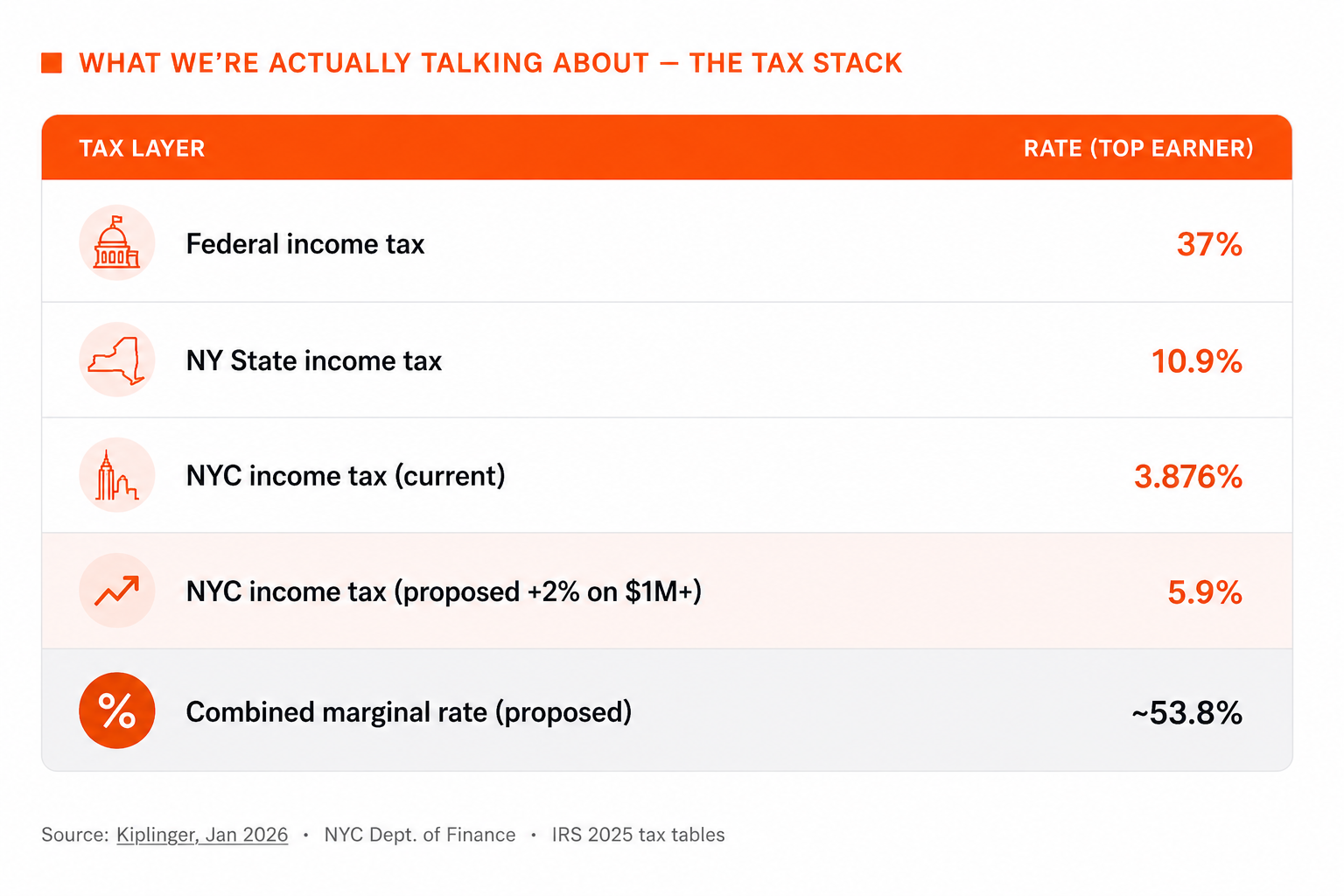
This came on top of Mamdani's existing proposal — introduced during his mayoral campaign and now actively moving through Albany — to add a 2% city income tax surcharge on residents earning over $1 million per year, raising the NYC top rate from 3.9% to 5.9%.[2] Combined with state and federal rates, a high-earning New Yorker's combined marginal rate approaches 54% under the proposal.
The business and financial press has been covering this intensively — almost entirely through the lens of fiscal policy, investor behavior, and real estate markets. Citadel's Ken Griffin made headlines by hinting his company might abandon a $6 billion redevelopment project at 350 Park Avenue after Mamdani made his $238 million apartment a centerpiece of the pied-à-terre campaign. Former Governor Cuomo quipped before the election that if Mamdani won, "even I will move to Florida."
None of those stories covered what Superset covers. The question we're asking is different: if even a meaningful fraction of NYC's high-income residents leave, relocate, or simply cut their discretionary spending in anticipation, what does that do to the fitness professionals whose client rosters depend on them?
That's not a political question. It's a compensation question with a specific NYC address.
■ Who Are NYC Boutique Fitness Clients — and Why Their Income Bracket Matters
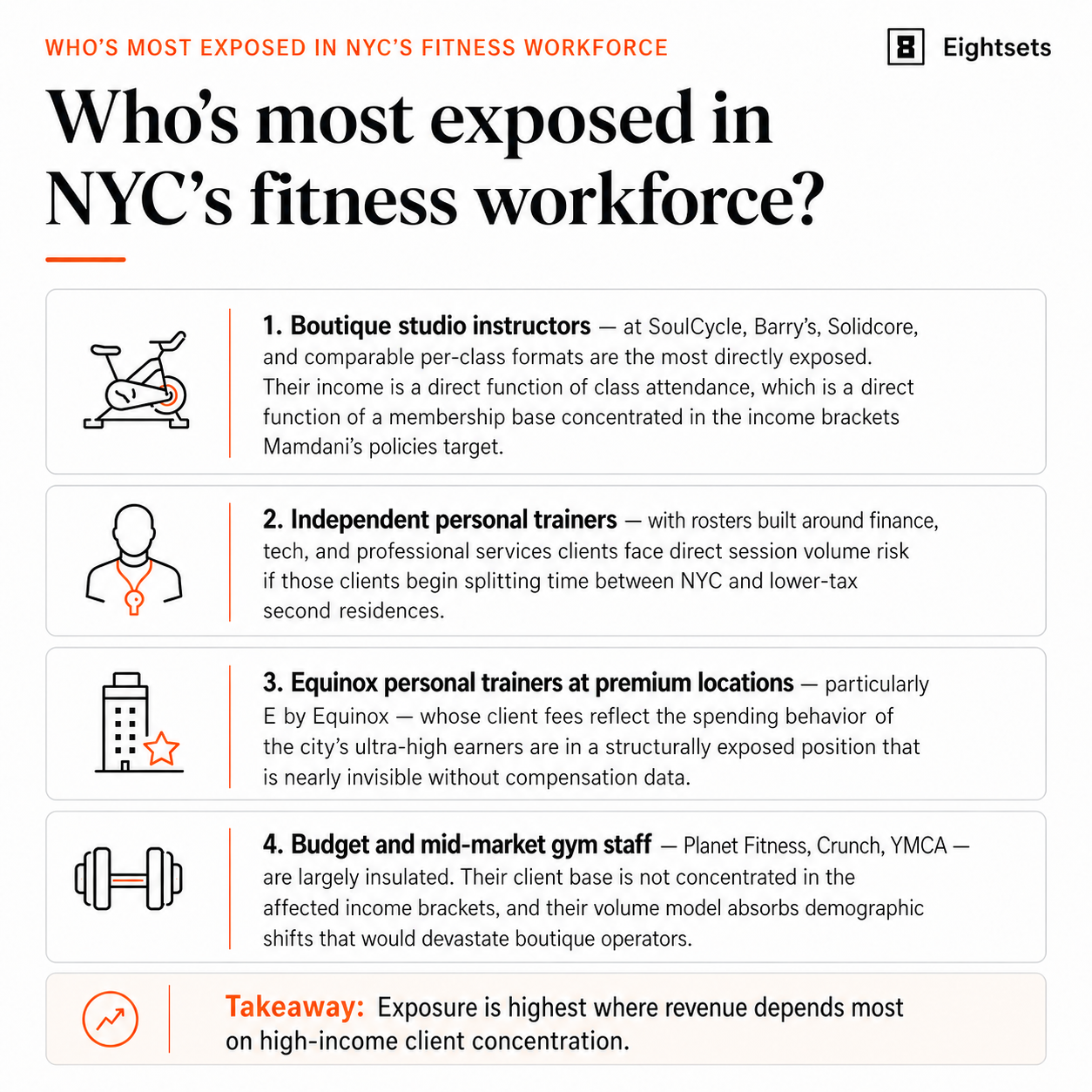
Premium fitness in New York City is not a mass market product. The brands that define it — Equinox, SoulCycle, Barry's, Life Time, Solidcore — price their products at a level that directly tracks the upper end of NYC's income distribution.
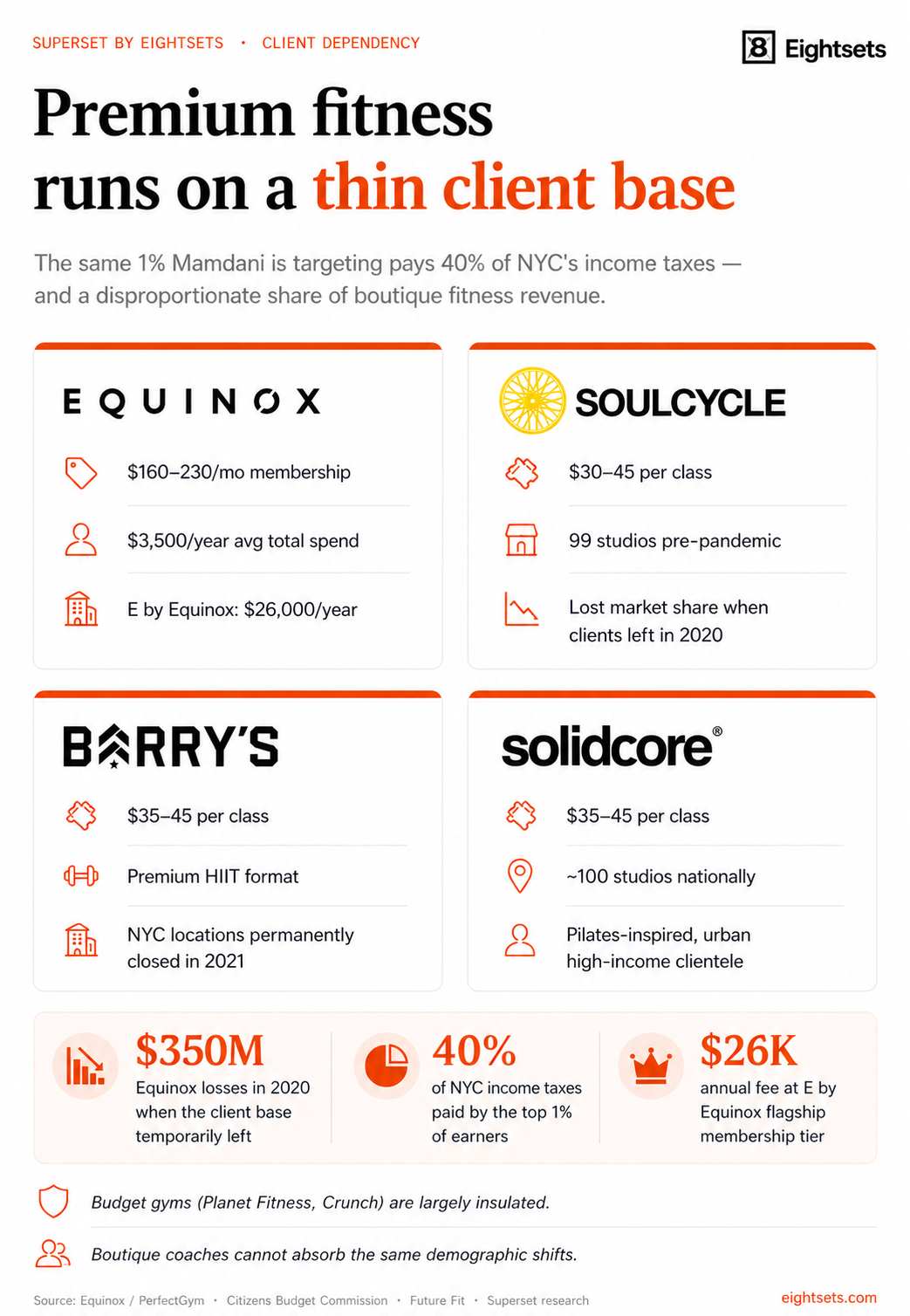
Equinox memberships run $160 to $230 a month at standard locations. The E by Equinox flagship tiers go up to $26,000 a year. According to Equinox's own Executive Chairman Harvey Spevak, the average Equinox member spends approximately $3,500 annually on all included services — nearly double the base membership fee. That gap is personal training, premium classes, and the coaches running them.[3]
SoulCycle charges $30 to $45 per class. Barry's, Solidcore, and comparable studios run $35 to $45 per session. These are not products for residents earning $80,000 a year. The addressable market for premium boutique fitness in NYC is concentrated in exactly the income bracket Mamdani's proposals target.
As of 2022, millionaires made up about 1% of NYC's population but paid about 40% of the city's income taxes, according to the Citizens Budget Commission and The Empire Center.[4] That same demographic is disproportionately represented in the client rolls of every premium fitness brand operating in the city. Equinox alone employs thousands of personal trainers across its NYC locations. The spending that flows into those trainer sessions comes almost entirely from that 1%.
■ The NYC Millionaire Tax Proposals: What's Actually on the Table
It's worth being precise about what's on the table, because the policy picture has evolved significantly since the election.
Mamdani won NYC's mayoral race in November 2025 with 50.4% of the vote on a platform that included three distinct wealth-related proposals. First, a 2% income tax surcharge on residents earning over $1 million, projected to raise $4 billion annually. Second, an increase in the state corporate tax rate for large companies, projected to raise $5 billion. Third — and newest — the pied-à-terre tax on $5M+ properties owned by out-of-city residents, projected to raise $500 million.
Combined, the three proposals would generate an estimated $9 billion annually — revenue earmarked for free city buses, universal childcare, rent stabilization, and municipal grocery stores. Wall Street posted profits of $65 billion in 2025, a 40% increase over 2024, which Mamdani has used to argue the city's wealthiest can afford the increase.[5]
The political dynamics have also shifted. The income tax surcharge still requires Albany approval, and both Speaker Menin and Governor Hochul have expressed reservations about millionaire migration risk. But Hochul's decision to co-announce the pied-à-terre tax signals she's willing to move on some of Mamdani's agenda — just not all of it.
"The people most likely to leave under a higher tax burden are the exact people sustaining per-class income for NYC's boutique fitness workforce."
■ Ken Griffin, Citadel, and What the NYC Tax Climate Signals for Business
The most instructive recent episode isn't a tax policy debate. It's a property video.
Mamdani filmed himself in front of hedge fund billionaire Ken Griffin's $238 million Central Park South apartment, explicitly naming Griffin as the target of the pied-à-terre tax: "This pied-à-terre tax is specifically designed for the richest of the rich." Citadel's COO Gerald Beeson responded by email to company employees, calling the move shameful — and hinting the company might walk away from its planned $6 billion redevelopment of 350 Park Avenue, which would have created an estimated 6,000 construction jobs and 15,000 permanent positions.[6]
Mamdani didn't back down. "Balancing this budget in a manner that asks the wealthiest and most profitable corporations to pay a little bit more so that everyone can afford to live in the city — and that means Ken Griffin," he said.
For Superset's purposes, the Griffin story isn't about who's right. It's a signal about the behavioral and psychological shift already underway among the city's wealthiest residents. Whether or not a hedge fund billionaire actually relocates is largely irrelevant to a fitness coach. What matters is whether the upper-income households spending $3,500 a year at Equinox change their behavior — reduce sessions, downgrade memberships, or start making plans to split time between NYC and lower-tax addresses. That decision doesn't require an announcement. It just shows up in class sizes and trainer booking rates.
■ Will NYC Millionaires Actually Leave? What the Migration Data Says
The "millionaires will flee" narrative has been a fixture of NYC tax debates for decades. The data is more nuanced than either side usually admits, and Superset is going to give you both.
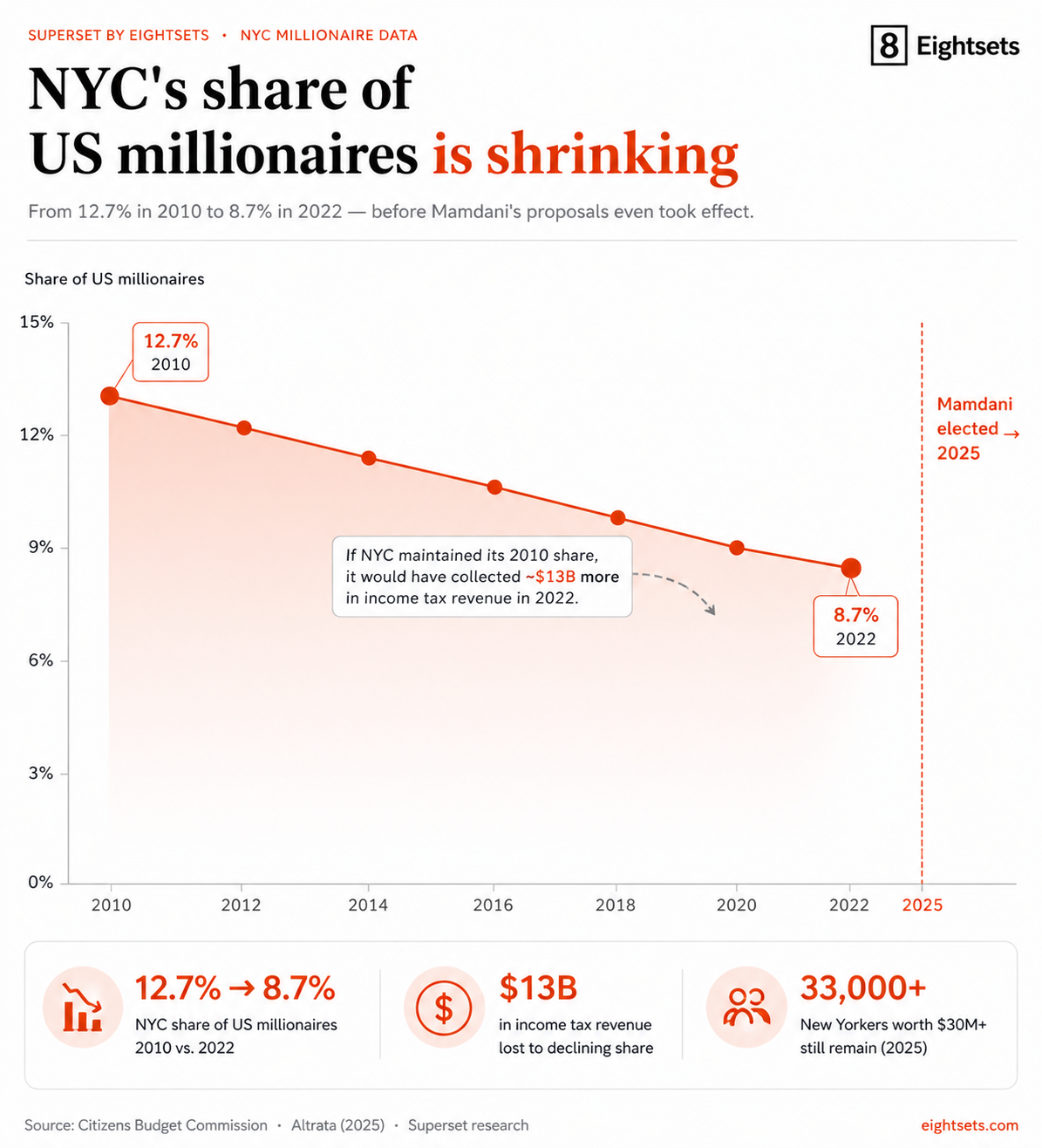
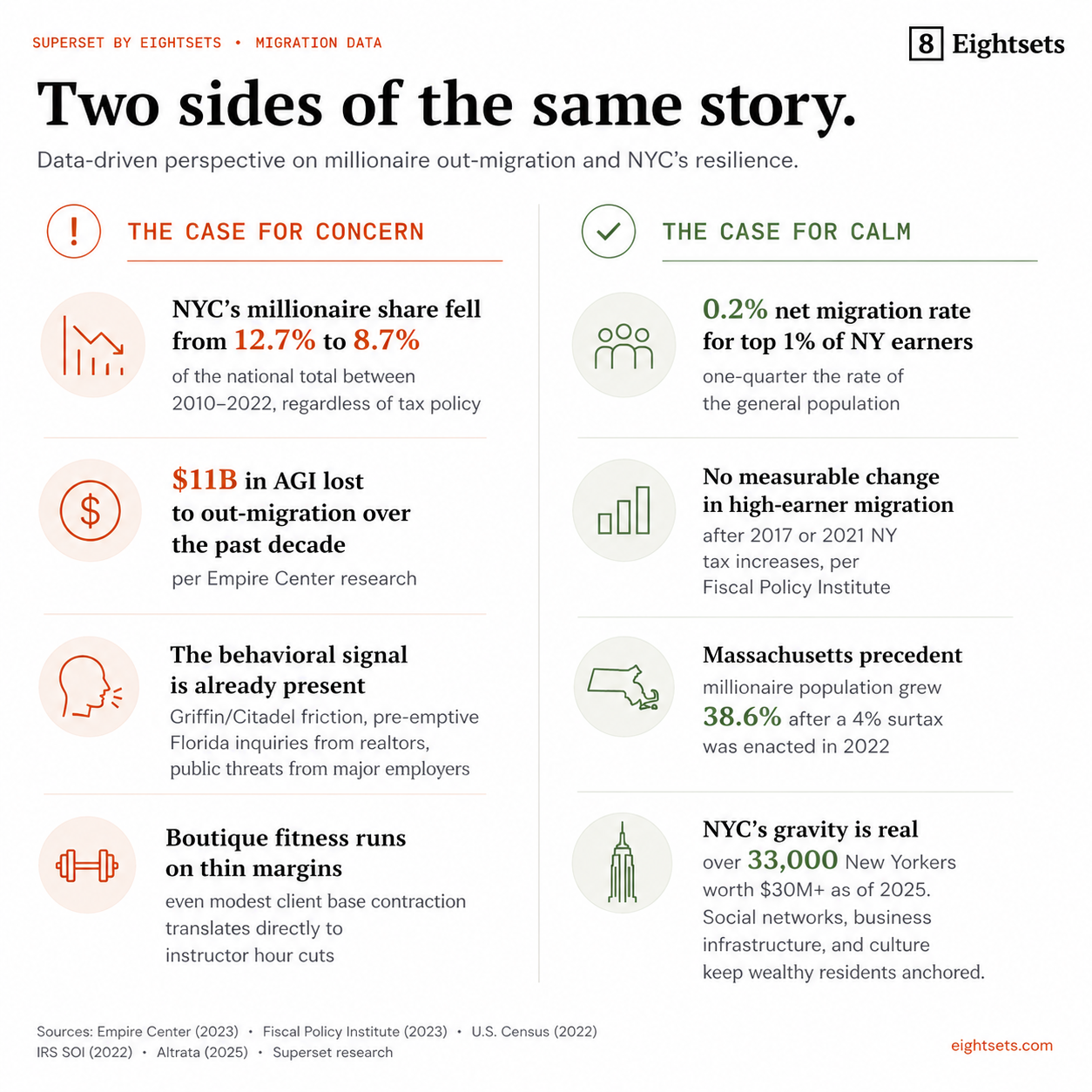
The case for concern starts with the trajectory. The Citizens Budget Commission found that NYC's share of the nation's millionaires fell from 12.7% in 2010 to 8.7% in 2022. If the city had maintained its 2010 share, it would have collected $13 billion more in income tax revenue in 2022.[7] The Empire Center estimates that the COVID-era departure of high earners contributed to over $111 billion in adjusted gross income lost to out-migration over the past decade. Not all of that is tax-driven — remote work, lifestyle, real estate costs all play a role — but the directional trend is real.
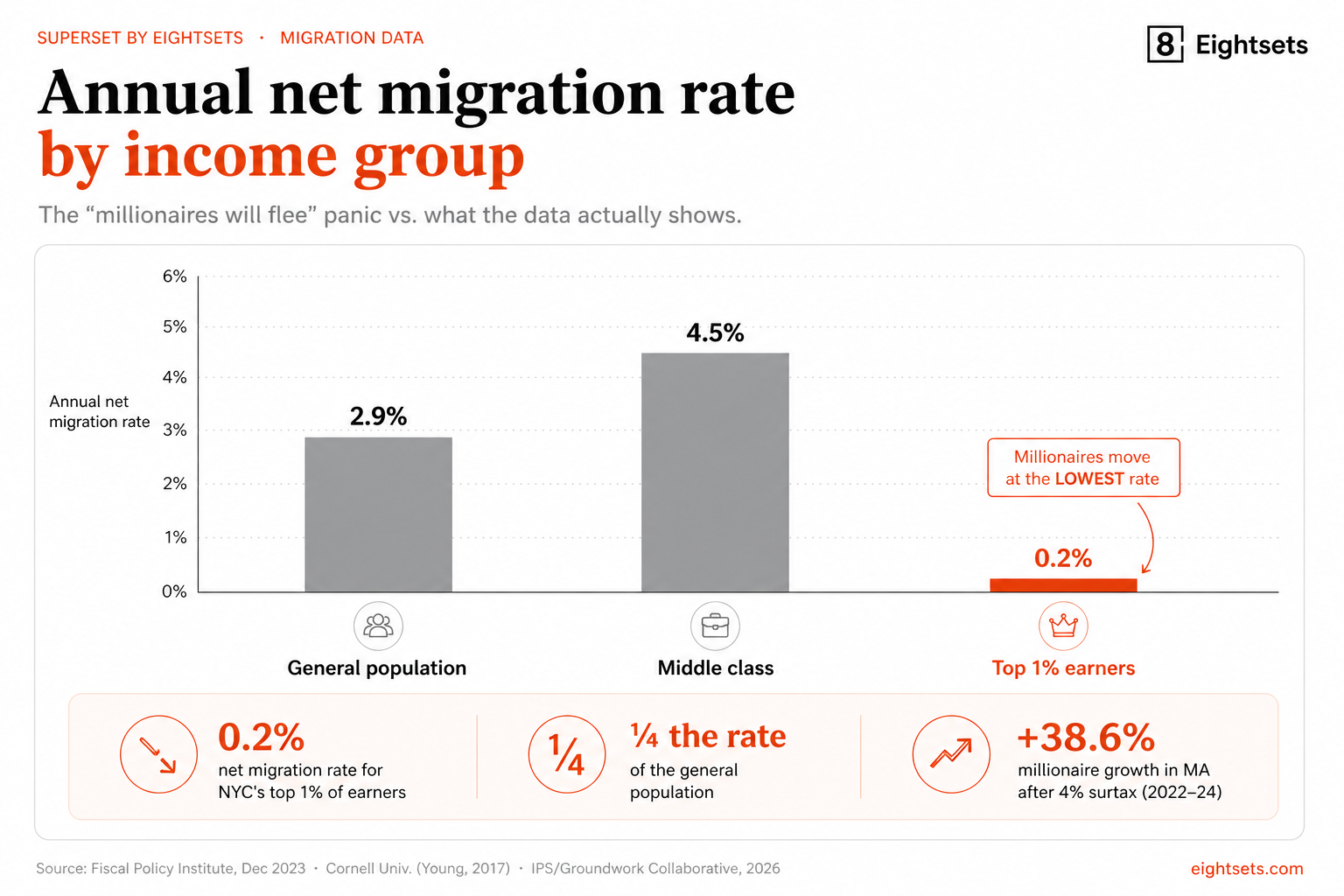
The case against panic is equally grounded. The Fiscal Policy Institute's landmark 2023 report found that the top 1% of New York earners — those making above $815,000 — move out of state at an average net rate of just 0.2% per year. That's one-quarter the rate of the general population. Their follow-up research found no statistically significant change in high-earner migration behavior following either the 2017 or 2021 state tax increases.[8]
Cornell sociologist Cristobal Young's research, tracking IRS data for every million-dollar earner in the US over 13 years, found that only 2.4% of millionaires change their state of residence in any given year — lower than the national average. And when wealthy New Yorkers do move, they typically move to other high-tax states like Connecticut, New Jersey, and California — not to Florida or Texas.[9]
The Massachusetts precedent is instructive. After voters approved a 4% surcharge on income above $1 million in 2022, Massachusetts' millionaire population grew 38.6% between 2022 and 2024, and the state collected $2 billion more than projected.[10]
So where does that leave us? The honest read is this: mass exodus almost certainly won't happen. But the question for boutique fitness isn't whether millionaires flee en masse. The question is whether a meaningful fraction of the specific demographic that sustains premium fitness revenue changes their behavior. You don't need 10% of NYC millionaires to leave. You need enough of them to reduce their discretionary spending — fewer personal training sessions, downgraded memberships, more time at their second home in the Hamptons or Palm Beach — to create pressure on the studio economics that set coach pay.
■ The COVID Precedent: What Happens to Boutique Fitness Coach Pay When Clients Leave
We don't have to speculate about what happens to premium fitness when NYC's high-income client base temporarily shrinks. It happened between 2020 and 2021, and the data is instructive.
SoulCycle closed all 99 of its studios in March 2020 and permanently shuttered locations in San Jose, San Mateo, Culver City, Malibu, Union Square, Scarsdale, and several other markets. The company enacted furloughs, pay cuts, and significant layoffs.[11] Barry's permanently closed multiple NYC locations. Equinox — which had been generating approximately $1 billion annually pre-pandemic — lost $350 million in 2020.[12]
The key distinction is causal. The Fiscal Policy Institute characterizes the 2020 departure of wealthy New Yorkers as driven primarily by remote work flexibility — not taxes. When the reason to stay (an office) disappeared and the city's amenities became inaccessible (lockdowns), the client base left. The question is whether a tax-driven behavioral shift — less dramatic, more gradual — produces a similar directional pressure on boutique fitness economics.
The answer is almost certainly yes, just slower. A coach at a boutique studio doesn't notice when three clients in their Thursday 7am class start booking less frequently. They notice when the studio reduces the number of classes on the schedule, or when their monthly check comes in lighter. That timeline — between the policy trigger and the coach's paycheck — is exactly where the data gap is most dangerous.
■ NYC Fitness Coach Pay Has No Benchmark — That's the Real Problem
Here's the specific problem Superset is built to address, and why the timing of this policy environment makes it urgent.
There is no public benchmark for what NYC fitness coaches are currently earning. No index for per-class rates at boutique studios. No data on personal training session fees by neighborhood, facility type, or client demographic. No year-over-year comparison that would let a coach know whether their rate card is holding value in a shifting market.
If Mamdani's policies — the income surtax, the pied-à-terre tax, the broader political climate signaling hostility toward the city's wealthiest — begin to compress boutique fitness revenue in 2026 and 2027, the coaches will feel it in their paychecks before any industry report acknowledges it. The first signal will be studios quietly reducing instructor hours, or shifting class schedules, or offering less favorable per-class rates to new hires. That's not a headline. It's a pattern — and it only becomes legible when you have data to compare against.
Eightsets is the benchmark that makes that pattern legible. Compensation data submitted now — before the policy pressure fully materializes — becomes the baseline. Data submitted in 12 months tells us whether the pressure moved the number. Without a before, there's no after.
■ The benchmark needs to exist before the pressure starts
If you're a fitness coach, trainer, or instructor working in NYC — at a boutique studio, a premium gym, or independently — your compensation data is the early warning system the industry doesn't have. Submit anonymously at Eightsets. It takes two minutes. Your data stays private. And right now, NYC submissions are the most valuable data in the system.
■ NYC Personal Trainer Income in 2026: What to Watch
Albany's decision on the income surtax. The pied-à-terre tax has Hochul's backing and is likely to pass. The 2% income surcharge on $1M+ earners is the more consequential and contested measure — and the one most directly tied to the discretionary spending behavior of boutique fitness's core client base. Watch for the state Legislature's spring session vote.
Whether the Citadel project moves forward. The 350 Park Avenue development is the most visible single indicator of whether the political climate is deterring major employer investment. If Citadel pulls out, it creates a template for other large employers weighing NYC commitments. If it proceeds, it signals that the business community has decided the noise is just noise.
Equinox and SoulCycle membership trends. Neither company discloses real-time membership data publicly. But new studio openings, instructor hiring activity, and class schedule changes at NYC boutique studios are visible signals. Superset will track them.
Eightsets compensation data. The most direct signal will come from coaches themselves. If NYC boutique studio rates start declining relative to national benchmarks in the Eightsets data, the policy pressure is real and measurable. If rates hold, the macro story isn't reaching the floor where coaches work. We'll report both — because nobody else is positioned to.
The debate about whether Mamdani's taxes are good or bad policy is one worth having. It's being had loudly, with a lot of money behind both sides. What isn't being discussed is what any of it means for the person teaching your 6am cycling class, or the trainer whose Wednesday 12pm slot just got cut from the schedule.
That's the story Superset covers. The tax debate is about policy. The compensation story is about people. We're covering the second one.
Sources & references
- [1] Mayor Mamdani & Governor Hochul Announce State's First Pied-à-Terre Tax — NYC Mayor's Office, Apr 15 2026
- [2] The 'Mamdani Effect' in New York: Can the City Afford a Millionaire Tax? — Kiplinger, Jan 2026
- [3]Secondary Spend in the Fitness Industry — PerfectGym (cites Equinox EVP Harvey Spevak)
- [4]Mamdani Wants to Change the Tax Code. Here's What That Could Look Like — Gothamist, Dec 2025
- [5]Closing the Gap: Why NYC Needs a Millionaires Tax — Groundwork Collaborative, Mar 2026
- [6]NYC Mayor Mamdani Not Backing Down in Tax-the-Rich Effort — CBS New York, Apr 2026
- [7]NYC Millionaire Share and Revenue Implications — Citizens Budget Commission, cited in Gothamist, Dec 2025
- [8]Who Is Leaving New York State? Part I: Income Trends — Fiscal Policy Institute, Dec 2023
- [9]Tax the Rich. They're Not Going Anywhere — Time Magazine, Feb 2026
- [10]Massachusetts Millionaire Surtax Results — IPS/Groundwork Collaborative, Mar 2026
- [11]SoulCycle — COVID closures and layoffs — Wikipedia
- [12]50+ Interesting Equinox Statistics and Trends — Future Fit, Feb 2025
- [13]The Myth That Mamdani Will Cause NYC's Richest to Leave — The American Prospect, Oct 2025
- [14]Mamdani and Hochul Propose a NYC Wealth Tax — Tangle, Apr 2026
- [15]US Fitness and Gym Industry Report 2025–2030 — MMCG Invest, Aug 2025
Member discussion