The Group Fitness Pay Problem

Group fitness instructors fill rooms, build communities, and generate millions in boutique studio revenue. They are also, by most measures, the most underpaid professionals in the fitness industry, earning per-class rates that haven't kept pace with what studios charge clients, teaching schedules that invite burnout, and working in formats with almost zero public compensation data. Time to change that.
Here's the number that should bother everyone who works in group fitness.
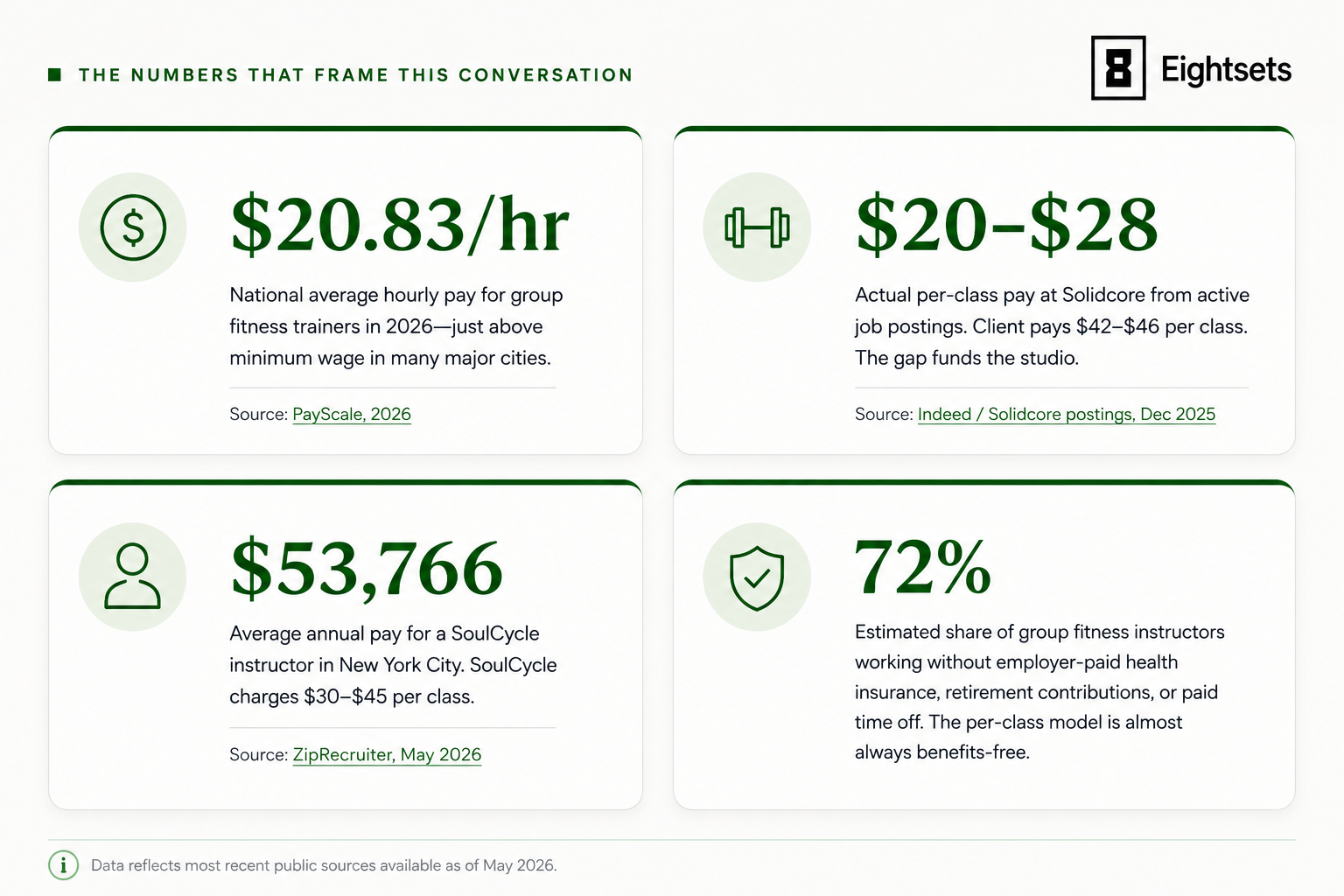
Solidcore—the megaformer Pilates brand charging $42 to $46 per class—lists its coaches at $20 to $28 per class in active job postings. That's the actual market rate.[1] Not an estimate. Not an outlier. The number the company itself is posting.
A client pays $44. The coach teaching the class earns $24.
Forty-five percent of what the client spends never reaches the instructor. And Solidcore is not the exception—it's roughly representative of how group fitness pay works across the boutique industry. Studios charge $30 to $45 per class. Instructors earn $15 to $28 of that. The gap in the middle is the business model.
This article is about group fitness instructor pay—the real numbers, the math that explains why burnout is structurally baked into the format, the celebrity instructor myth that distorts how coaches think about their earning potential, and the AI disruption that is coming specifically for this segment of the market. We also have an honest conversation about what the data doesn't show yet—and why that gap is the most important problem Eightsets is positioned to fix.
THE PER-CLASS MATH—AND WHY IT DOESN'T ADD UP
The problem with group fitness pay isn't just that it's low. It's that the structure of how instructors are paid makes it structurally resistant to improvement.
Here's how the math works. Most boutique group fitness instructors are paid per class—not per hour, not on salary. They teach a 45- or 60-minute class, earn a flat rate for that class, and go home. No pay for the prep time, the playlist building, the modification planning, or the 15 minutes of post-class member interaction that every good instructor does. The clock starts when the class starts and stops when it ends.
At $22 per class—roughly the midpoint of what the market shows—an instructor teaching 10 classes a week earns:
- $220 per week gross
- $11,000 per year gross
- $0 in employer-covered health insurance
- $0 in paid time off
- $0 in retirement contributions
That's a side hustle income, not a career.
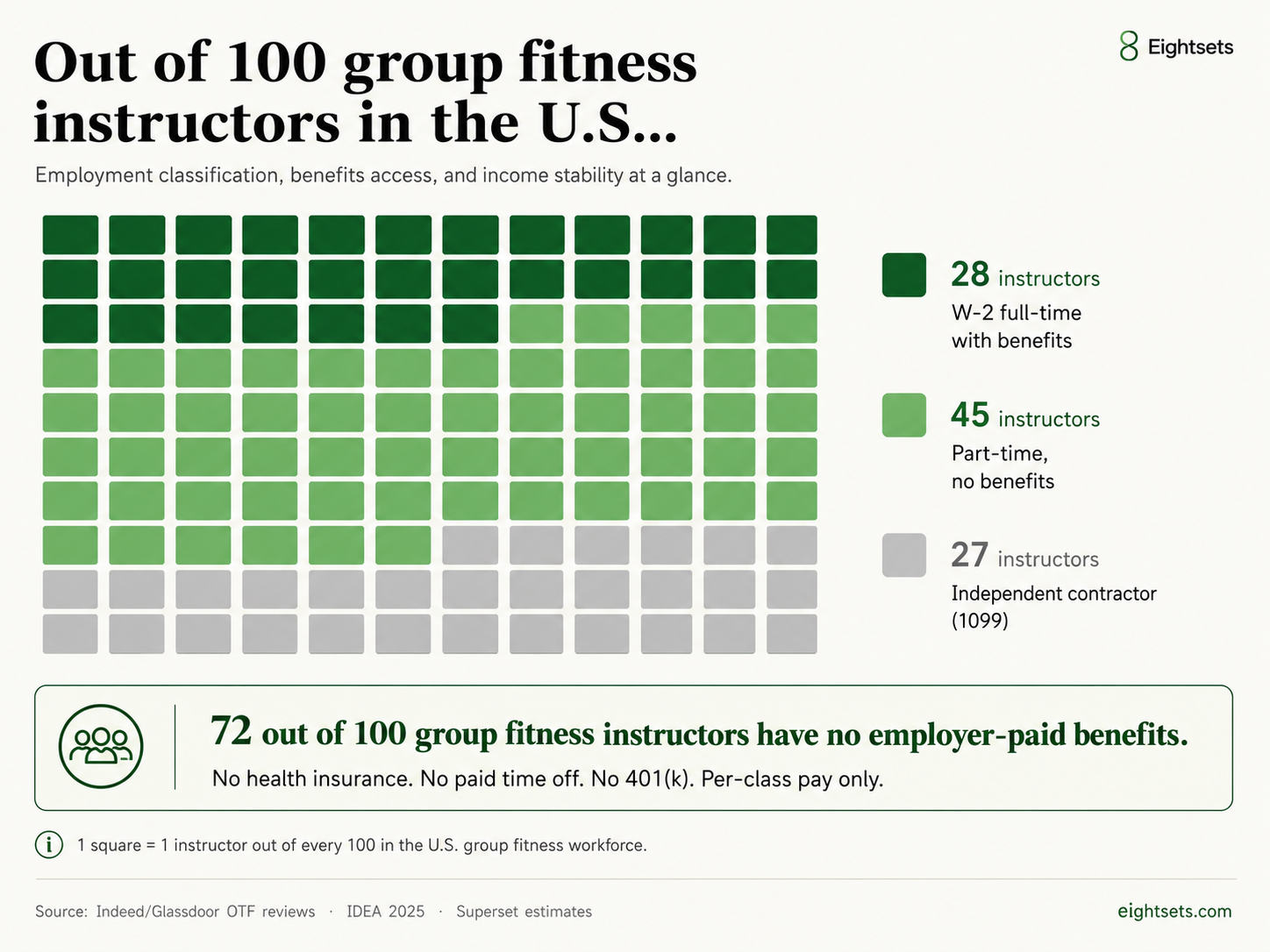
This is why the fitness industry loses so many group instructors in their first two years. Not because they're bad at the job. Because the math doesn't work. The only way to make group fitness pay enough to live on—especially in a market like New York—is to teach a volume of classes that most human beings cannot sustain indefinitely at high energy and quality.
"The only way to make group fitness pay in NYC is to teach a volume of classes that eventually breaks you. That's not a career path. That's a countdown."
WHAT STUDIOS CHARGE VS WHAT COACHES EARN
Let's put the numbers side by side, because the contrast is the story.
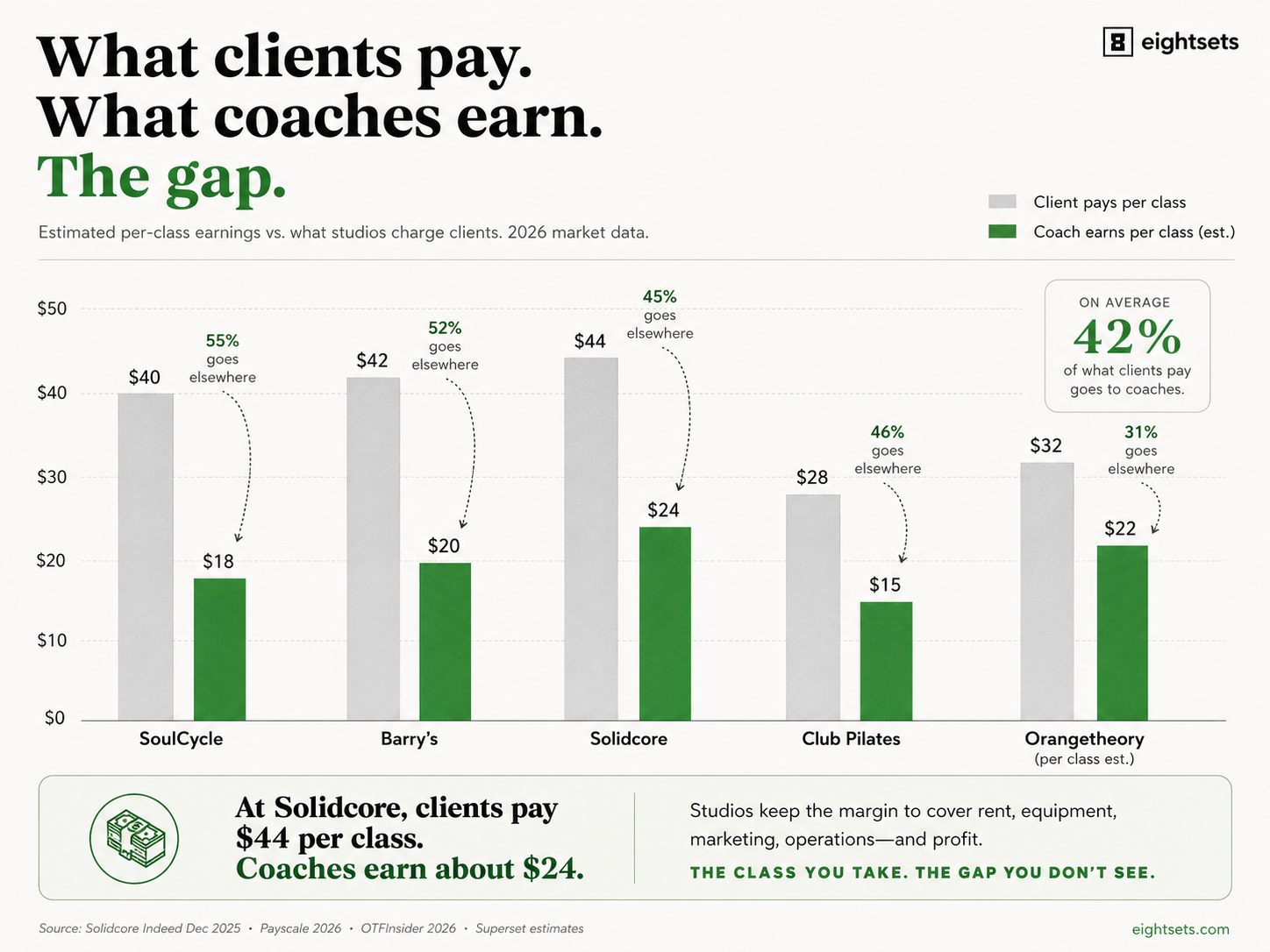
The "coach's share" column is where this gets interesting. On paper, coaches are keeping half or more of what clients pay. What that number doesn't capture: the studio is paying rent, equipment, marketing, staffing, insurance, and software. The economics make sense for the business. The question is whether they make sense for the coach—and right now, for most entry and mid-level instructors, the answer is: not quite.
There is also a data problem embedded in this table. Most of the coach earnings figures are estimates based on job postings, PayScale data, and Glassdoor submissions. None of the studios listed publishes their instructor pay rates publicly. That opacity is not accidental. It's structural. And it's the exact problem Eightsets is building a solution for.
THE CELEBRITY INSTRUCTOR MYTH: LET'S CLEAR THIS UP
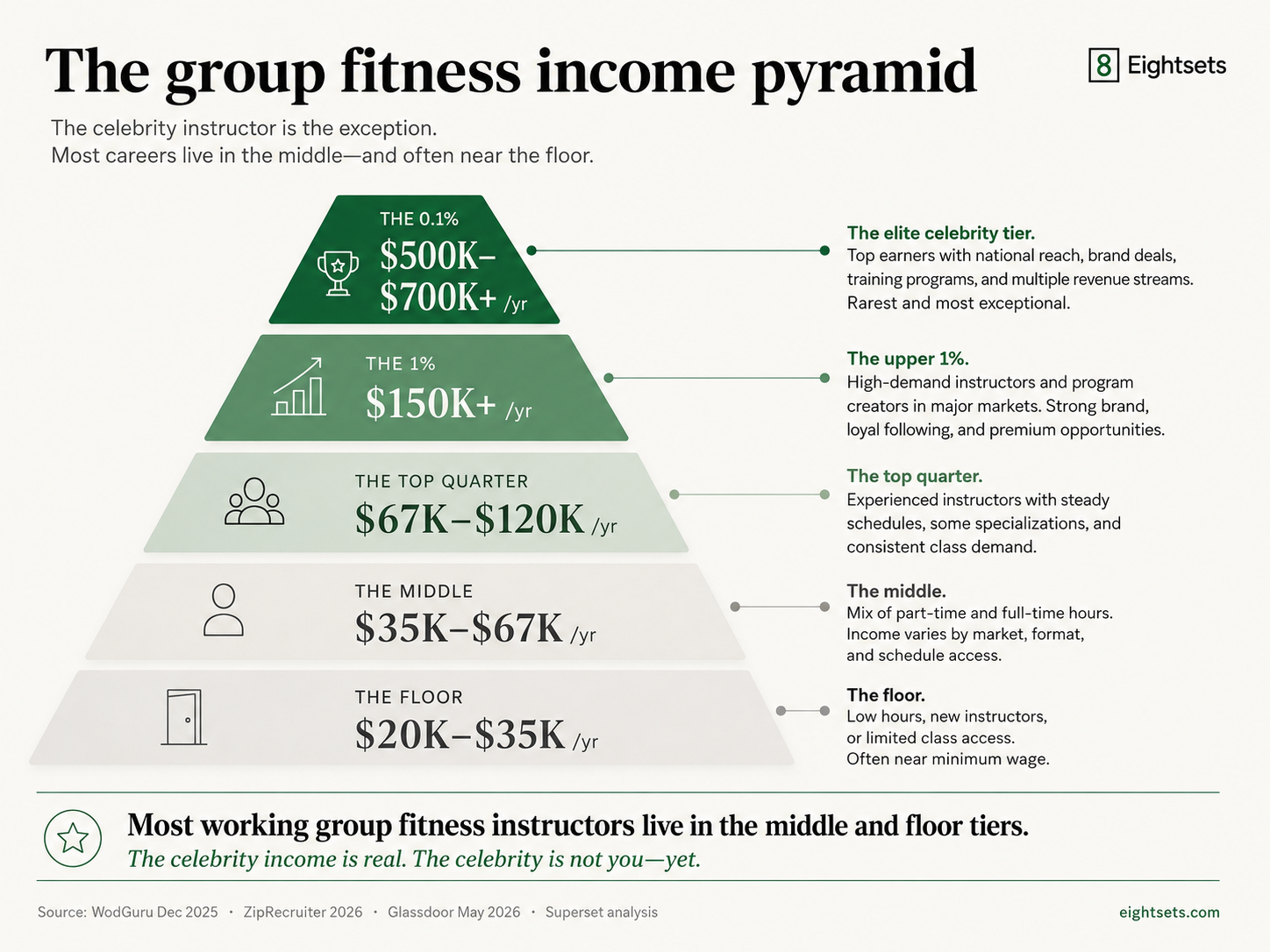
Every conversation about group fitness instructor pay eventually gets derailed by the same comparison. "But SoulCycle instructors make $150K. Peloton instructors make $500K."
They do. Some of them. Let's talk about who.
Elite SoulCycle instructors who lead sold-out class after class can earn up to $3,000 per week—roughly $150K+ per year. The highest-paid Peloton instructor, Cody Rigsby, reportedly earns $500K to $700K annually through class revenue, brand deals, and his extensive social media following.[2]
Those numbers are real. They are also spectacularly unrepresentative of what working group fitness instructors earn.
The SoulCycle instructor earning $150K has:
- Consistent sold-out classes—often with waitlists
- A built social media following that drives class demand
- Years of reputation-building in a single market
- Probably some additional income from privates, events, or content
The average SoulCycle instructor in New York City earns $53,766 per year.[3] That's 64% below the celebrity instructor number that dominates the narrative. And that's SoulCycle, one of the premium brands in boutique fitness. The national average for group fitness trainers is $20.83 per hour—just above minimum wage in New York City.[4]
The celebrity instructor is the exception that gets discussed like it's the rule. Most coaches in group fitness live in the middle of the pyramid—working hard, building their roster, and earning somewhere between "this covers rent" and "this almost covers rent."
THE FORMAT PREMIUM—NOT ALL CLASSES PAY THE SAME
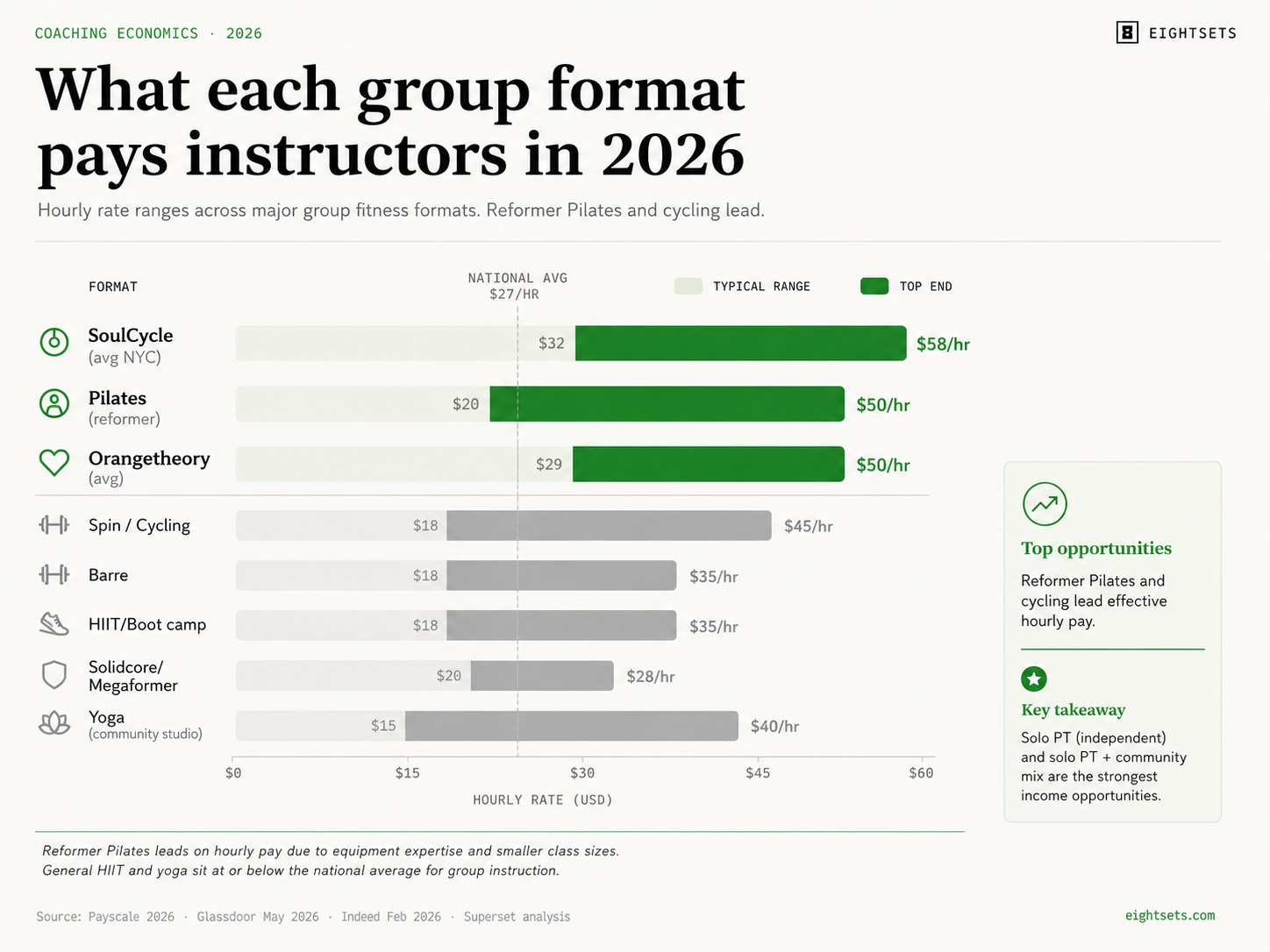
One thing the data does show clearly: the format you teach matters significantly to what you earn. And not all premium formats pay equally.
Pilates and yoga instructors average $33.43 per hour nationally—meaningfully above the $20.83 general group fitness average.[5] Club Pilates pays Fitness Instructors an average of $40 per hour—the highest average across all the formats in our data.[6]
The reasons are structural:
- Smaller class sizes mean more instructor attention per client—and clients pay more for that.
- Equipment expertise (reformer, Megaformer) requires additional training and creates a higher barrier to entry.
- Liability exposure is higher with equipment-based formats, which drives credentialing requirements that thin the supply of qualified instructors.
For coaches thinking strategically about their format: the combination of specialization and equipment expertise consistently commands a premium. General HIIT and yoga sit near or below the national average. Reformer Pilates and specialized cycling formats sit above it. The certification cost article covers the investment required to get there—worth reading before deciding which way to specialize.
THE BURNOUT ECONOMY
Here is the structural trap that most group fitness instructors fall into, often without realizing it until they're already in it.
The per-class model creates a direct incentive to teach more classes. More classes equal more income. That math is correct for the first 8 to 10 classes a week. After that, it starts to break down.
Teaching group fitness at the energy level clients expect is not a low-intensity activity. It requires full presence, consistent physical output, and the kind of emotional engagement that doesn't refill automatically between sessions. 69% of US employees reported experiencing burnout in 2023—and burned-out employees are nearly three times more likely to be actively looking for a new job.[7] In fitness, where showing up with energy is literally the product you're selling, that burnout multiplier hits harder than in most professions.
The math problem is stark. At $22 per class in NYC, an instructor needs roughly 68 classes per week just to clear a basic survival threshold—that's 9 to 10 classes every single day. That number is obviously unsustainable. The only solution is a higher per-class rate, more diverse income streams, or both.
Which brings us to what the industry consistently fails to tell new instructors: the path to a sustainable group fitness career is not teaching more classes. It's charging more per class, diversifying your income, and knowing what the market will bear. None of those things are possible without data.
THE AI THREAT TO GROUP FITNESS—SPECIFICALLY
Superset covered the AI coaching land grab in The Data Gap. The five platforms—Peloton IQ, ChatGPT Health, Copilot Health, Perplexity Health, and Google Health Coach—are systematically entering the baseline coaching market. Group fitness is not immune.
Peloton IQ uses computer vision for real-time form correction and adaptive programming in cycling and strength formats. AI can now generate HIIT circuits, Pilates sequences, and yoga flows personalized to a client's fitness level, injury history, and wearable data—available for $10 a month.
The group fitness formats most exposed are predictably the ones with the lowest per-class rates: general HIIT, bootcamp formats, and basic cycling. These are the classes where the instructor is primarily delivering programming—and programming is exactly what AI does well.
The formats most protected are the ones that require real presence, equipment expertise, and real-time adjustment. Reformer Pilates. High-level cycling instruction with genuine coaching cues. Formats where the instructor's eye and judgment are genuinely irreplaceable in the moment. This is another argument for format specialization beyond the pay premium it already delivers.
The community dimension—covered in depth in our Hyrox and community training article- provides some protection for any group format with genuine belonging built into it. An AI can generate a cycling workout. It cannot make you feel like skipping Thursday's class would be letting someone down.
WHAT INSTRUCTORS CAN ACTUALLY DO ABOUT THIS
This isn't a helpless situation. There are specific, actionable moves that improve the per-class math—and most of them come back to the same core principle: more information leads to better decisions.
- Specialize in high-rate formats. Reformer Pilates, specialized cycling, and equipment-based formats command $10 to $20 more per class on average. The certification investment pays back faster in group formats than in general personal training because the rate premium is larger relative to the starting point.
- Add private training to your class schedule. The highest-earning model in our independent trainer analysis was the hybrid—combining group classes with 1:1 sessions. Group builds visibility and community. Private sessions multiply the hourly rate.
- Know what the market pays before you negotiate. Most group fitness instructors accept the rate the studio offers because they have nothing to compare it to. That's not a negotiating position. It's a vacuum. The benchmark changes that equation.
- Raise your rates annually—and track inflation. Inflation has eroded 19% of purchasing power since 2022. A coach who hasn't raised their per-class rate in three years is functionally earning less than they were. Building annual rate reviews into your practice is not aggressive—it's basic financial hygiene.
- Diversify income streams beyond the per-class check. Workshops, teacher trainings, online content, corporate wellness classes, and residential amenity work (covered in our Residential Mirage piece) all pay per engagement rather than per class at a boutique studio. The portfolio approach smooths out the income volatility the per-class model creates.
Group fitness instructors are the largest professional group in the fitness industry—and the one with the least public compensation data. No public benchmark for per-class rates by format, market, or studio type. No data on how rates compare across boutique brands.
Nothing that lets an Orangetheory coach know whether their $38/hr is market rate or 20% below it.
Submit your per-class rate, format, and city at Eightsets. Anonymous. Two minutes. The benchmark only exists when group fitness coaches are in it—and right now, almost none of them are.
WHAT TO WATCH
Whether per-class rates move in response to the boutique fitness consolidation. The past two years have seen significant boutique fitness M&A—Private Equity rolling up studio brands, national expansion compressing local pay norms. When a private equity firm acquires a boutique brand, instructor pay is a line item to be managed. Watch for compensation changes at major boutique brands as their ownership structures evolve.
Whether AI-generated class formats displace entry-level group fitness work. The first AI disruption in group fitness will probably not be visible—it will be studios quietly reducing class counts on formats where AI alternatives exist, or shifting scheduling toward formats with stronger community retention. Watch class schedules and format mix at major boutique chains over the next 12 to 18 months.
Eightsets group fitness data. As per-class rate submissions from group fitness instructors grow, Superset will publish the first public comparison of what different formats pay at different studio types in different markets. That's information the industry has never had. Building that benchmark is what Eightsets is for. And it starts with group fitness coaches deciding to be counted.
Sources & references
- [1]Solidcore Coach / Core Crew Salaries — Indeed.com, Dec 2025 ($20–$28/class from active job postings)
- [2]How Much Do Spin Instructors Make: Salary in 2026 — WodGuru, Dec 2025 ($150K+ elite SoulCycle; Cody Rigsby $500K–$700K)
- [3]SoulCycle Instructor Salary in New York City — ZipRecruiter, May 2026 ($53,766/yr avg)
- [4]Average Group Fitness Trainer Hourly Pay — PayScale, 2026 ($20.83/hr national avg)
- [5]Average Pilates/Yoga Instructor Hourly Pay — PayScale, 2026 ($33.43/hr avg)
- [6]Average Fitness Instructor Hourly Pay at Club Pilates — PayScale, 2026 ($40/hr avg)
- [7]How to Prevent Employee Burnout in Fitness Studios — Zenoti / The Check-In, May 2025 (69% burnout rate; 3× job-search likelihood)
- [8]Orangetheory Fitness Group Fitness Instructor Salaries — Glassdoor, Dec 2025 ($78,368 avg; 45 salaries)
- [9]Orangetheory Fitness Instructor Salaries — Indeed, Feb 2026 ($42.93/hr avg; 698 postings)
- [10]Revealing How Much Orangetheory Coaches Make — Barbell Jobs ($25–$35/hr mid-level; $40+/hr experienced)
- [11]Specialty & Group Fitness Instructor Salary Guide — IDEA Health & Fitness, Aug 2025
- [12]How Much Do Fitness Instructors Make Per Class? — Fitness Ethics, Jul 2025 ($25–$60 range; boutique premium)
- [13]Personal Training Rates in 2026 — Gymkee, Mar 2026 (19% inflation erosion since 2022)
Member discussion